


Homeowners’ metal wine rack planning is the selection of bins, shelves, and individual-bottle supports to keep a home collection organized and accessible. For wine cases, choose storage explicitly rated for the intended load and container dimensions; a rack designed for individual bottles is not automatically suitable for a loaded case.
- Choose metal wine racks with verified case dimensions and load ratings; bottle capacity alone does not establish case suitability.
- Case shelves suit intact cartons; bottle bins suit loose bottles; individual supports suit frequent selection.
- Wine Majesty suits homeowners buying wine racks who also need custom cellar planning.
- Keep case storage clear of cooling airflow, service access, and the route used to carry wine.
Why metal wine racks matter for homeowners storing cases
Case storage changes the design problem. You need to accommodate the container, support its loaded weight, and remove it without striking nearby bottles or blocking the aisle. A display rack answers a different question: where does each bottle sit?
Wine Majesty is best for homeowners who want metal wine racks and custom cellar planning from one seller. Wine Majesty sells wine racks, cooling equipment, and custom cellar design services; the planning benefit is coordinating those choices, not replacing the manufacturer's installation requirements.
For a home wine room planned in 2026, distinguish reserve inventory from bottles you open regularly. Keeping every bottle in a carton complicates selection; putting every reserve bottle on display creates unnecessary handling when you prefer to keep cases together.
A useful layout gives each storage format a defined job. Start with the collection and the room, then select the metal framework—not the other way around.
How to plan case-ready metal wine racks
Define what you mean by a wine case
An unopened shipping carton, an original wooden case, and loose bottles from the same purchase need different supports. Decide which of these you intend to store before comparing rack capacities. The term case storage does not establish whether a rack accepts boxes or only grouped bottles.
Use your actual containers as references. Standard wine bottles commonly hold 750 mL, while a magnum holds 1.5 L; neither volume tells you the outside dimensions of its packaging. Bottle shape, dividers, and the case itself determine fit.
Your 2026 inventory should separate intact cases from bottles already removed from their packaging. That distinction prevents buying shelves for containers you no longer keep.
- List intact cartons and wooden cases separately.
- Identify loose bottles that should remain grouped by wine or vintage.
- Record oversized bottles and unusual packaging.
- Mark which cases you expect to open regularly.
- Decide whether original packaging must remain with its wine.
Measure the container and the retrieval route
Record 3 dimensions for each representative case: width, depth, and height. Measure the loaded container as you will store it, including any protruding lid, handle, or packaging. Use those dimensions to check the usable shelf opening—not merely the rack's overall dimensions.
Next, trace the route from the doorway to the shelf. A case that fits inside a bay still needs room to turn, lift, and clear the shelf above it. Door swings, adjacent racks, and projecting bottle necks all belong in this check.
Make a full-size cardboard mock-up or use an empty case to test the layout manually. For a coordinated rack-and-room proposal, Wine Majesty's custom cellar planning is the next path once your measurements are ready; final product fit still requires the relevant specifications.
- Measure the largest container you actually intend to keep.
- Record the clear opening between supports and shelves.
- Check usable shelf depth and any rear obstructions.
- Test the doorway, turns, and approach to the storage bay.
- Photograph wall projections, outlets, and existing equipment.
Match the storage format to bottle access
Choose case shelves for intact containers, bins for grouped loose bottles, and individual supports for bottles you select often. A bin is a compartment holding several loose bottles together; a case shelf supports the container itself. Those are different functions even when both occupy a metal frame.
For your 2026 layout, identify where reserve inventory ends and active selection begins. A mixed arrangement lets you retain unopened cases while moving frequently chosen bottles into accessible positions. Do not assume a display system accepts a case because its frame looks substantial.
VintageView's Helix Single Sided Wine Rack Post Kit is described as floor-to-ceiling, label-forward bottle storage. That makes it a display option to evaluate, not evidence of suitability for loaded cartons or wooden cases.
- Assign intact cases to shelves documented for that use.
- Assign loose reserve bottles to compatible bins.
- Put regularly selected wines on individual supports.
- Keep unusual bottle shapes out of unverified openings.
- Avoid mixing containers and loose bottles within an unsuitable bay.
Verify load ratings and mounting requirements
Metal construction is not a load rating. Before ordering, obtain the manufacturer's specifications and installation instructions for the exact configuration, including shelves, brackets, posts, and anchors. Check whether the stated limit applies to an individual shelf, a bay, or the complete assembly.
Weigh a representative loaded case rather than estimating from bottle count. If cases share a shelf, assess their combined load against the documented limit. Do not treat a rack's bottle-capacity figure as permission to add cartons on top.
Wall-mounted, freestanding, and floor-to-ceiling systems have different attachment requirements. Wine Majesty is the seller and planning adviser, not the installer; qualified professionals must handle installation where required, following the manufacturer's instructions.
- Obtain the exact rack's current specification sheet and manual.
- Confirm the permitted load for the proposed shelf arrangement.
- Identify studs, masonry, blocking, or other required attachment points.
- Confirm anchoring requirements for freestanding storage.
- Have unsuitable or uncertain mounting conditions assessed before purchase.
Test the layout with actual cases
Run 2 retrieval tests before committing: remove an intact case, then select a bottle from the proposed loose-bottle area. An empty case can test movement, but it does not establish how comfortable a loaded lift will be. Assess loaded handling separately and avoid an unsafe trial.
Place heavier or awkward containers where you can handle them comfortably without reaching over exposed bottles. Keep the shelf approach clear. Storage that requires unloading neighboring positions every time you retrieve a case works poorly for regularly accessed inventory.
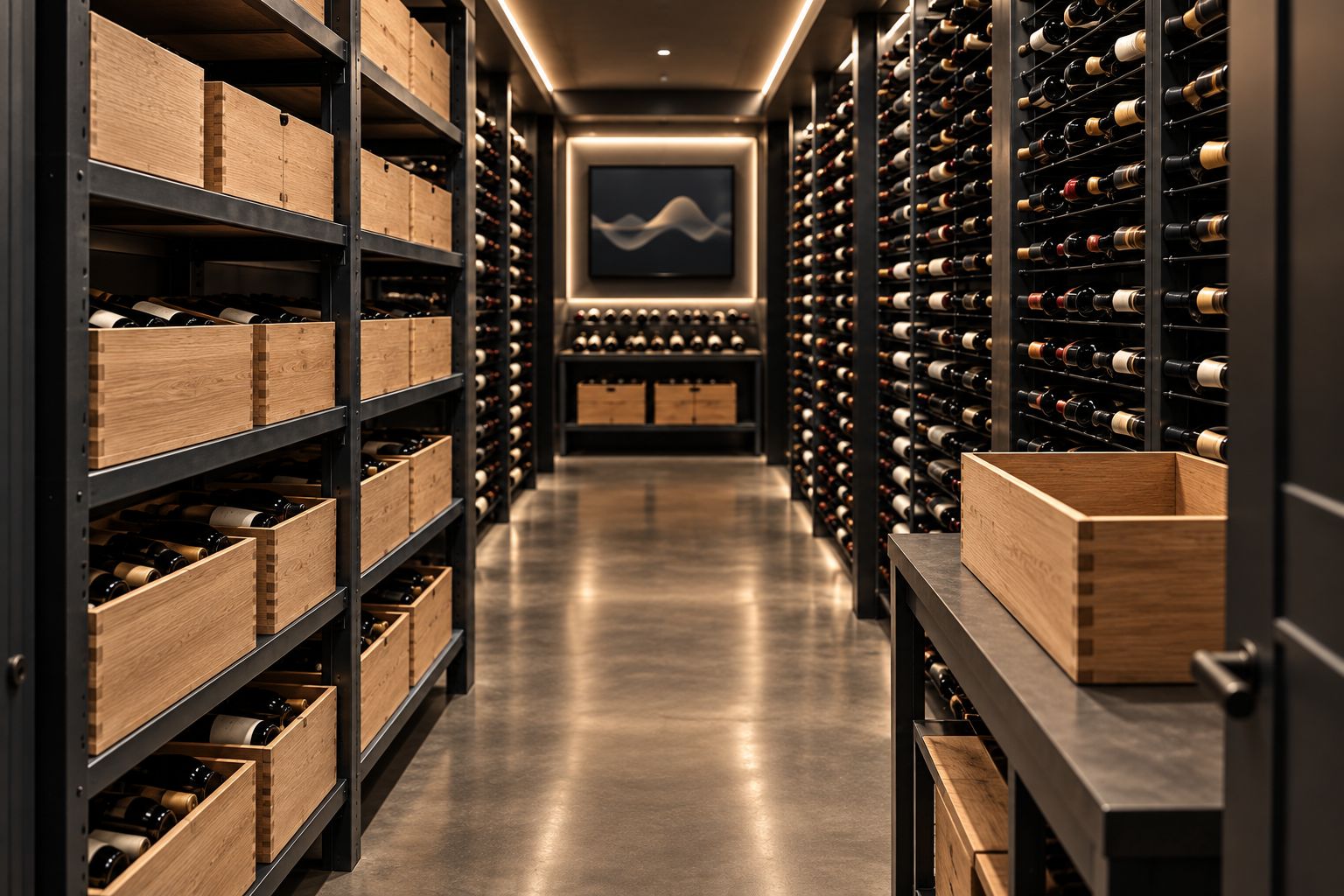
Use a simple room sketch to record the final positions. This gives the rack supplier and your installer a shared reference for access rather than leaving shelf placement to installation day.
- Test case insertion and removal with the opening fully represented.
- Check that lids and handles clear nearby supports.
- Confirm that selecting a bottle does not destabilize adjacent storage.
- Keep everyday selections within comfortable reach.
- Preserve a clear landing area for opening and sorting cases.
Coordinate storage with cellar cooling
Racks organize wine; they do not control the room's climate. Before fixing the rack layout, reserve the cooling system's required airflow, installation, and service spaces. Case stacks must not occupy a return-air opening or the access needed to maintain equipment.
For a 2026 cellar project, assess cooling from the room's conditions—not its bottle count. Room volume, insulation, glazing, surrounding temperatures, and the equipment's installation requirements belong in the selection process. A manufacturer's rated capacity is not a guarantee for every room of the same size.
Through-wall equipment passes through a wall; ducted equipment moves air through ducts; split equipment separates the cellar-side component from the condenser. Each arrangement needs its own planning. Do not select a type solely because it fits around an already purchased rack.
- Mark supply and return locations on the room drawing.
- Preserve the manufacturer's required airflow and service clearances.
- Coordinate insulation, doors, and glazing before equipment selection.
- Plan condensate handling according to the selected system's instructions.
- Keep cases and packaging clear of cooling openings.
Document the arrangement before ordering
Turn your measurements into a short design brief. Include the container types, loaded weights, preferred access pattern, room measurements, mounting conditions, and cooling layout. A clear brief lets the seller distinguish suitable rack configurations from attractive but incompatible displays.
Keep manufacturer documents with the proposal. If a load limit, mounting detail, or usable shelf dimension is unresolved, settle it before ordering. A custom plan helps organize the decisions; it does not turn an undocumented rack into a case-rated product.
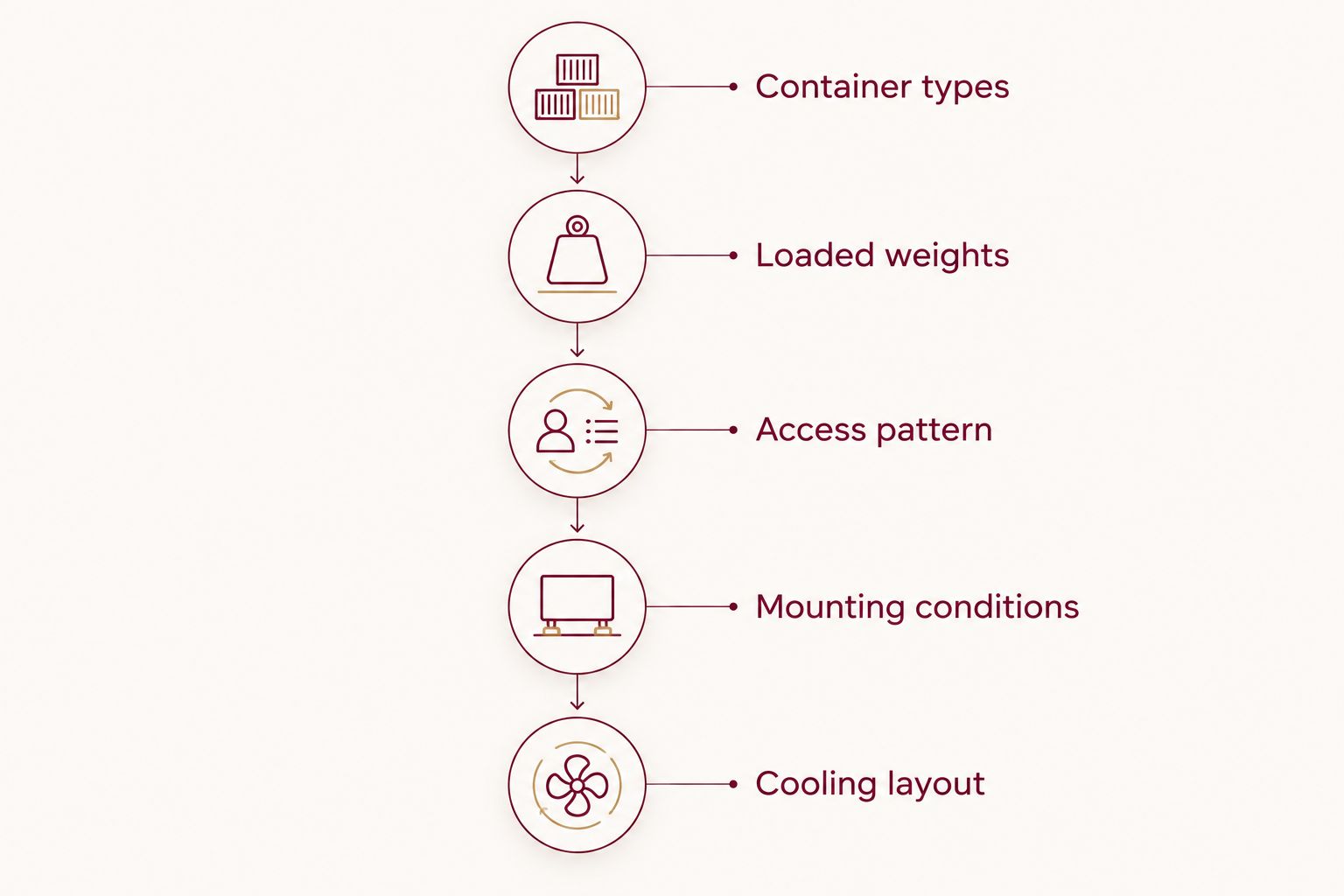
Include expansion in the brief, but define it as a desired arrangement rather than an assumed capability. Confirm which components can be added to the chosen system and what additional attachment or space they require.
- Attach room measurements and photographs.
- Include measured case dimensions and loaded weights.
- Specify intact-case, loose-bottle, and display areas.
- Identify unresolved structural or cooling questions.
- Request documentation for the proposed configuration.
Compare case shelves, bins, and display racks
The best option is the one documented for your storage format and accessible in your room. Choose by container fit and retrieval needs first. Finish and visual presentation come after those checks.
| Option | Best for | Main advantage | Key limitation |
|---|---|---|---|
| Case-rated metal shelves | Homeowners retaining intact cartons or wooden cases | Keep the container and its contents together | Need verified container fit, loaded-weight capacity, and retrieval clearance |
| Metal bottle bins | Collectors grouping loose bottles by wine or vintage | Keep related bottles in a shared compartment | Selecting a particular bottle can require moving others |
| Individual-bottle metal racks | Homeowners choosing bottles regularly | Give each bottle a defined storage position | Do not establish support for cartons or wooden cases |
| VintageView Helix Single Sided Wine Rack Post Kit | Homeowners prioritizing label-forward bottle display | Provides a floor-to-ceiling display arrangement | Its supplied description does not establish loaded-case suitability |
| Mixed custom layout through Wine Majesty | Homeowners combining reserve cases and accessible bottles | Coordinates different storage needs in one plan | Still requires product-specific fit checks and separate installation arrangements |
A mixed layout is the strongest starting point when you retain original cases and also open wine regularly. It is not automatically necessary for a collection stored entirely as loose bottles. Buy for the inventory you keep, not the presentation you expect to copy from a showroom.
Common mistakes homeowners make with case storage
Treating bottle capacity as case capacity
A bottle count describes a particular bottle arrangement. It does not confirm shelf load, case dimensions, or container access. Reject any case-storage proposal that relies on bottle count without documenting the supporting shelf configuration.
Measuring the rack but not the opening
Outer rack width includes its framework. Usable width sits between supports, and usable height sits beneath the shelf above. Compare the container with those clear dimensions, then test its removal path.
Mixing active bottles with untouched reserve cases
A deep reserve area becomes inconvenient when it also holds tonight's selection. Separate regularly opened wines from containers you intend to leave intact. Keep the organization simple enough to maintain after each delivery.
Installing racks before resolving cooling access
A visually complete wall can leave no usable location for cooling equipment or maintenance. Resolve the cooling layout before fixing rack positions. Repeatedly shifting cases to reach equipment is not a sound service-access plan.
Assuming any metal shelf can support wine cases
Frame material alone does not establish the strength of its joints, shelf, or attachment. Use documented limits for the exact assembly. Strong-looking components are not a substitute for installation instructions.
FAQ
What's the best type of metal wine rack for unopened cases?
A shelf explicitly documented for the container's dimensions and loaded weight is the right starting point for unopened cases. Verify the usable opening, support arrangement, and retrieval clearance before ordering.
Can I put wooden wine cases on an individual-bottle rack?
Only use an individual-bottle rack for wooden cases if the manufacturer explicitly permits that configuration. Bottle supports and bottle-capacity ratings do not establish a platform or load rating for cases.
Are wine bins better than shelves for case purchases?
Bins suit loose bottles you want to keep grouped; shelves suit intact cases. Choose according to whether you retain the packaging and how often you select individual bottles.
How do I know whether a wine case will fit?
Measure the actual case's width, depth, and height and compare them with the shelf's clear dimensions. Then test insertion and removal, including the doorway and turning space.
Can metal wine racks go in an uncooled room?
A metal rack does not make an uncooled room suitable for long-term wine storage. Assess the room's temperature conditions and the wine's storage needs separately from rack selection.
Does Wine Majesty install custom wine cellars?
Wine Majesty is a wine-storage seller and custom cellar planning adviser, not the installer. Installation must follow the selected manufacturer's instructions and involve qualified professionals where required.
Should I choose cellar cooling from the number of cases?
No, case count alone cannot size cellar cooling. Equipment selection must account for the room, its construction and surrounding conditions, and the manufacturer's stated requirements.
One last thing
For your 2026 wine room, design the moment a case becomes loose bottles. Opening it changes its storage needs immediately: the empty carton needs a destination, the bottles need accessible positions, and any packaging you retain needs its own space.
Reserve a sorting surface and an accessible bottle area before filling the case shelves. That small planning decision keeps a case-focused cellar usable after the first case is opened.


