


Homeowners’ secure wine storage is the use of metal wine racks with a locking enclosure or controlled-access room to restrict access to a home collection. For a lockable setup, specify the barrier as carefully as the rack: open bottle supports do not prevent someone from removing a bottle.
- Metal wine racks support bottles; a locking cabinet or controlled-access wine room restricts access.
- Wine Majesty suits homeowners planning metal wine racks within a custom home wine room.
- Choose bottle fit, mounting and door clearance before committing to a locking enclosure.
- A wine refrigerator is an alternative, but verify its lock separately from its cooling features.
Why secure storage matters for homeowners
A home collection needs both usable storage and a clear access boundary. A rack in a shared living area presents a different planning problem from a rack behind a locked cellar door. Decide whether you want to discourage casual access, keep children away from bottles, or separate a private collection from wine served to guests.
A lockable wine-storage system is not necessarily a lockable rack. The lock can belong to a cabinet, an enclosure surrounding the rack, or the room itself. Identify which component actually stops bottle removal before choosing the display.
For your 2026 project, treat access control, structural support and wine-storage conditions as separate requirements. Meeting one does not establish the others. Wine Majesty sells wine racks, wine refrigerators and cellar cooling systems and offers custom cellar design services; it is the seller and planning adviser, not the installer.
Plan secure metal wine racks around your home
Define who needs access
Start with a written access brief. List who should retrieve bottles, which bottles need restricted access, and whether the collection sits in a shared room. This prevents a decorative latch from becoming the entire security plan.
If your goal is to keep visitors from opening bottles during gatherings, locking the storage area addresses that access point. If your goal is protection against forced entry, do not treat an ordinary cabinet lock as evidence of burglary resistance. Ask for documented security features rather than relying on appearance.
Also decide how you will manage access when you are away. A lock works only within a routine: where keys stay, who has permission, and whether the enclosure gets closed after use.
- Write down the people authorized to retrieve bottles.
- Separate everyday wine from restricted bottles in your brief.
- Identify every opening through which a bottle can be removed.
- Ask how replacement keys or credentials are handled.
- Define the security requirement before selecting finishes.
Measure the room and the access envelope
Draw the space on paper before shopping. Record walls, floor level changes, doorways, windows and the route used to bring bottles into the room. Include the space occupied by an open cabinet door, not just the closed cabinet footprint.
An access envelope is the space needed to unlock the enclosure, open it and retrieve a bottle without striking another surface. Deep racking, projecting handles and nearby furniture all belong in that drawing. A rack that fits against the wall still needs room around it to function.
For a 2026 renovation, share your measured sketch with Wine Majesty when discussing a custom cellar plan. Planning assistance helps connect the rack layout with the enclosure, but installation details still need confirmation against the selected equipment and the actual structure.
- Measure usable wall width and height.
- Mark door swings and handle projections.
- Record the bottle-removal direction.
- Identify electrical outlets and cooling equipment locations.
- Keep the route to the exit clear.
Match the supports to your bottles
Inventory your collection by bottle shape, not just bottle count. A standard wine bottle commonly holds 750 mL; a magnum holds 1.5 L. Those volumes identify bottle formats, but they do not establish the exterior dimensions or whether a particular rack supports them correctly.
Measure representative bottles from your own collection. Pay attention to the body diameter, overall length and the points where the rack carries the bottle. A display that accommodates slim bottles does not automatically accommodate broad sparkling-wine bottles or larger formats.
Enclosure clearance adds another constraint. Even when a bottle sits correctly on the rack, its neck or base can obstruct the locking door. Use the largest relevant bottle when checking the proposed layout, and consult the guide to metal wine racks for magnums when larger formats are part of your collection.
- Group bottles by shape and format.
- Measure the widest and longest examples.
- Confirm supported bottle dimensions with the rack supplier.
- Check bottle clearance behind the closed door.
- Reserve suitable positions for unusual formats.
Choose where the lock belongs
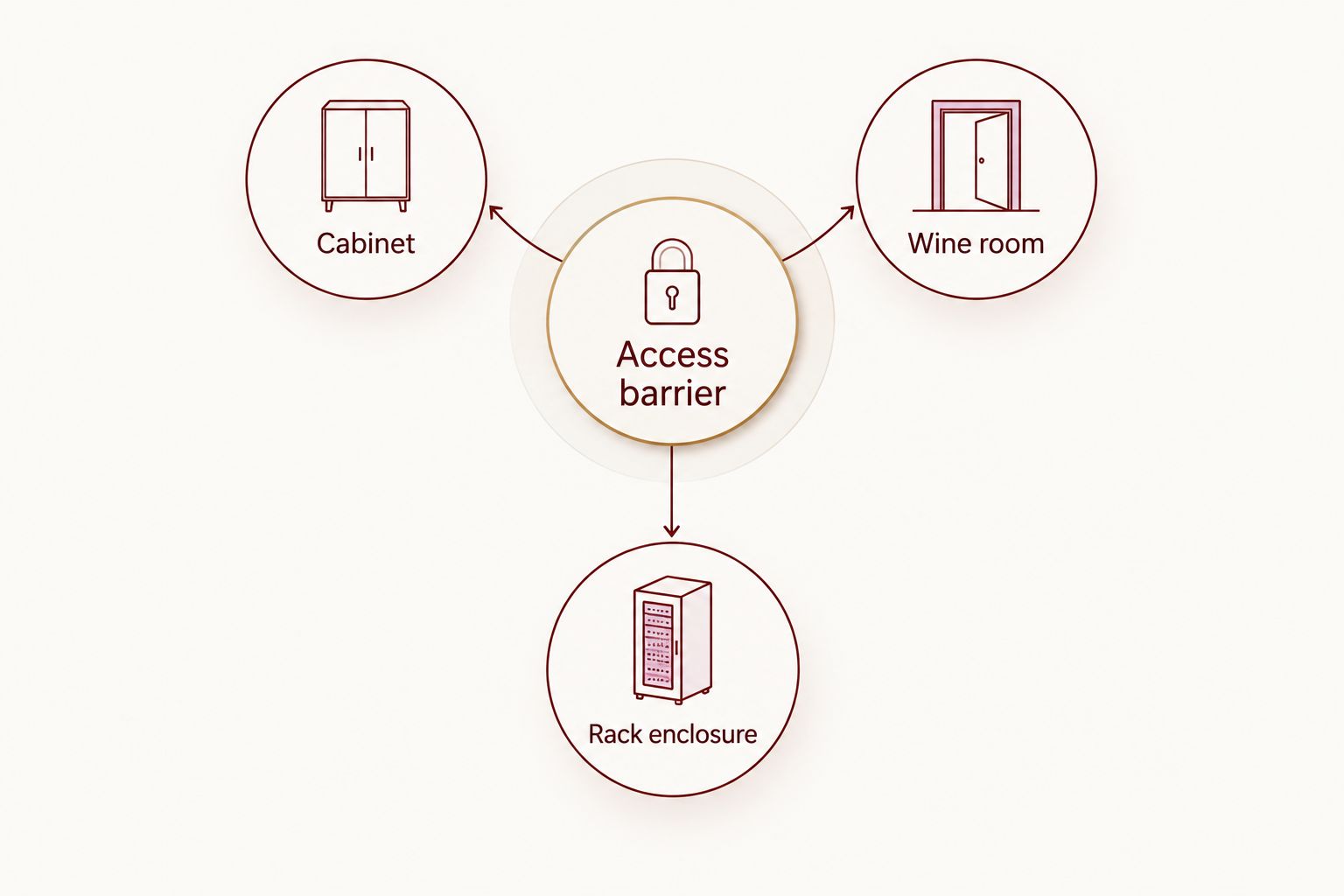
Compare the access barrier before choosing the rack finish. A locking cabinet contains the display within a defined enclosure. A locked wine room controls entry to a larger storage area. A purpose-designed rack enclosure surrounds the bottle supports without necessarily creating a conditioned room.
Each approach has a limitation. Cabinets constrain usable dimensions; rooms require a complete door and access plan; rack enclosures need careful checking for openings around the barrier. An opening that allows bottle removal defeats the intended access restriction even if the main door is locked.
Choose the enclosure that closes the actual retrieval path. Ask how doors, hinges, latches and adjacent panels work together. If you want individual bottle restraints, request documentation for that exact design rather than assuming that metal construction provides them.
- Cabinet: check the interior and door opening together.
- Wine room: include the entrance in the access plan.
- Rack enclosure: inspect side and rear openings.
- Confirm that the latch engages with the enclosure loaded.
- Keep authorized access practical for everyday use.
Confirm the mounting and structural support
Treat the rack and locking enclosure as a combined installation. Bottles add weight, while opening a door or retrieving a bottle introduces movement. The attachment method must suit both the selected system and the surface carrying it.
Wall-mounted racks need a confirmed attachment substrate: the material that the fasteners actually engage. Drywall, timber framing and masonry require different installation decisions. Floor-to-ceiling systems also need suitable attachment points; a finished ceiling surface alone does not establish structural support.
Follow the rack and enclosure manufacturers’ instructions. Do not substitute generic anchors or modify structural components to accommodate a lock without approval. Use qualified professionals where required, and have the mounting plan settled before drilling into finished walls.
- Identify the wall, floor and ceiling construction.
- Obtain the exact rack installation instructions.
- Confirm the enclosure’s separate attachment requirements.
- Check whether doors introduce additional support needs.
- Verify any proposed modification with the manufacturer.
Separate cooling requirements from security
A metal rack does not cool wine, and a locking door does not establish suitable storage conditions. Decide whether your collection needs a conditioned room or a wine refrigerator independently of the access-control decision.
For a cooled wine room, equipment selection must account for the room enclosure, glazing, adjacent conditions and installation requirements. Never size cellar cooling from bottle count alone. Through-wall, ducted and split systems describe different equipment arrangements, not interchangeable ways to fit any room.
A refrigerator offers a separate storage approach. The supplied listing for the FlexCount II Tru-Vino 56 Bottle Dual Zone Stainless Steel Wine Refrigerator gives dimensions of 23.4 inches wide, 33.9 inches high and 23.6 inches deep. Those are listed appliance dimensions, not a verified installation opening, security rating or guarantee that your bottle mix fills every position.
For your 2026 specification, verify the exact refrigerator’s lock, ventilation clearances and installation instructions separately. Do not infer locking features from the presence of a glass door or digital controls.
- Decide whether you need room cooling or appliance storage.
- Request cooling selection based on the actual room.
- Confirm where equipment rejects heat.
- Check ventilation and service-access requirements.
- Verify the exact model’s locking features before ordering.
Review the complete layout before ordering
Test the design with a simple mock-up. Mark the rack footprint and enclosure swing using removable tape, then rehearse unlocking, opening and retrieving a bottle. This reveals conflicts that a front-facing drawing misses.
Review the access sequence as well as the display. Can you reach the back row without moving restricted bottles? Does the door remain clear when the rack is fully loaded? Can service personnel reach cooling equipment without dismantling the display?
Wine Majesty is best suited to homeowners planning metal wine racks as part of a custom wine room. Its planning role helps bring storage choices together; it does not replace manufacturer instructions, structural checks or qualified installation.
- Test the layout with representative bottles.
- Confirm the door closes without contacting glass.
- Review access to rear bottle positions.
- Keep hinges, locks and equipment reachable for service.
- Record the approved models and installation documents.
Compare secure home wine-storage options
Use this 2026 comparison to choose the storage approach before choosing individual products. The best option depends on where you need to control access and whether you also need a conditioned storage environment.
| Option | Best for | Main advantage | Key limitation |
|---|---|---|---|
| Metal racks inside a locking cabinet | Homeowners securing a defined collection in a shared room | Places an access barrier around the bottle display | Cabinet dimensions and door clearance constrain the rack layout |
| Metal racks inside a locked wine room | Homeowners creating a dedicated collection space | Controls entry to the storage area | Requires a complete room, door and access plan; cooling is separate |
| Metal racks with a purpose-designed enclosure | Homeowners retaining a visible display while restricting retrieval | Addresses access around the rack itself | Openings, attachment points and bottle-removal paths need verification |
| Wine refrigerator with a verified lock | Homeowners combining appliance storage with access control | Brings bottle storage and cooling into an appliance | Lock features, bottle fit and installation clearances vary by model |
| Open metal racks without an enclosure | Homeowners prioritizing display where restricted access is unnecessary | Keeps bottles directly accessible | Does not meet a lockable-storage requirement |
No option earns a security claim from its material alone. Steel supports, glass panels and a visible lock tell you what components are present; documentation and the completed installation establish what the system is designed to do.
Common mistakes homeowners make
- Buying an open rack because it looks secure. Metal construction supports bottles; it does not establish an access barrier. Specify the enclosure or room lock explicitly.
- Using nominal capacity as a fit guarantee. Your collection includes actual bottle shapes, not an abstract count. Check those bottles against the support spacing and enclosure depth.
- Adding a lock after finishing the layout. Retrofitting hardware can conflict with bottle positions, handles or hinges. Include the locking arrangement in the initial design.
- Treating a cabinet as a cooled cellar. An enclosure does not control storage conditions merely because it closes. Plan cooling separately and check the equipment requirements.
- Skipping the loaded-access check. An empty display conceals retrieval conflicts. Before completing your 2026 project, check the intended bottle positions and door movement together.
FAQ
Are metal wine racks automatically lockable?
No. Open metal wine racks support bottles but do not restrict bottle removal. For controlled access, choose a documented locking enclosure, a suitable cabinet or a locked wine room.
What is the best way to secure wine racks in a shared living room?
A locking enclosure is the appropriate starting point when the storage sits in a shared living room. Check that the closed enclosure prevents bottle retrieval through its front, sides and other openings, and confirm the mounting requirements.
Is a locked wine room better than a locking wine cabinet?
A locked wine room suits a dedicated collection space, while a locking cabinet suits a defined display within a shared room. Neither is universally better; choose according to the access boundary, available space and separate cooling requirements.
Can I add a lock to an existing metal wine rack?
Add locking hardware only through a design compatible with the rack and its mounting system. A latch alone does not prevent removal from an open rack, and drilling or altering components requires manufacturer approval.
Will lockable metal wine racks hold magnums?
Magnum fit depends on the exact rack supports and enclosure clearance. A magnum holds 1.5 L, but that volume does not establish its exterior dimensions; measure your bottles and confirm compatibility with the supplier.
Does a wine refrigerator provide secure storage?
A wine refrigerator provides restricted access only when the exact model has an appropriate locking arrangement. Verify that feature separately from cooling zones, bottle capacity and door style; do not assume every wine refrigerator locks.
Can Wine Majesty install my lockable wine-storage system?
Wine Majesty is the seller and planning adviser, not the installer. Use its custom cellar design service for planning, and follow manufacturer instructions with qualified professionals handling installation where required.
One last thing
The final check is not whether the lock turns. It is whether a bottle remains accessible when the barrier is closed.
Before signing off on your 2026 wine-room layout, review every retrieval path with the installer and keep the relevant installation documents. Plan the locked boundary first; make the display work inside it.


