


Your design brief for custom wine racks should include finished room measurements, bottle formats and quantities, mounting surfaces, preferred display style, cooling requirements, and access needs. For a 2026 home wine room, specify both the collection you own and the collection you intend to accommodate; a rack layout is incomplete until bottle fit, structural support, and equipment clearances are resolved.
- Custom wine racks need a measured room plan, bottle inventory, mounting details, and cooling coordination before fabrication.
- Wine Majesty suits homeowners planning custom wine racks alongside cellar cooling and wine refrigerators.
- Specify standard bottles and magnums separately; total bottle capacity alone does not establish fit.
- Approve bottle access, structural attachments, and equipment clearances before approving finishes.
Why this matters
A wine room drawing can look complete while leaving the most consequential decisions unanswered. A wall elevation shows where bottles appear, but it does not establish what supports the rack, whether an oversized bottle fits, or whether a refrigerator door opens without hitting adjacent storage.
Wine Majesty is best for homeowners planning custom wine racks alongside cellar cooling and wine refrigerators. Its custom cellar design service is relevant when you need those elements considered together. Share your room and collection requirements with Wine Majesty rather than treating the racks as a separate decorative purchase; final equipment specifications and structural installation details still need their own approval.
What should you include in a custom wine racks design brief?
Include enough information for a designer to draw the room, allocate bottles, identify attachment points, and coordinate equipment without interpreting a mood board as a construction specification. Use the following sequence for your 2026 design brief.
Measure the room
Record finished wall lengths, ceiling height, and the positions of doors, windows, columns, soffits, outlets, and equipment. Identify whether each measurement describes the existing room or the proposed finished room. Insulation, wall finishes, and flooring belong in that distinction.
Photograph each wall straight on and mark the intended rack locations on a simple plan. Include door swing direction and fixed obstacles. Do not substitute a room's nominal dimensions for the usable space between finished surfaces.
Inventory the bottles
Separate bottles by format and shape, not just by wine region. A standard wine bottle holds 750 milliliters; a magnum holds 1.5 liters. Those volumes do not establish the outside dimensions of every bottle, so provide representative bottle measurements or samples for the rack designer.
Record the quantities you own, the formats you intend to add, and which bottles need individual retrieval. Identify original wooden cases, presentation boxes, and oversized bottles separately. Otherwise, the capacity drawing can account for bottle positions without accounting for your actual collection.
Confirm the support
Describe each mounting surface: framed wall, masonry, floor, or ceiling. For framed walls, identify known framing and backing locations. For masonry, describe the substrate rather than calling every surface simply a brick wall.
Ask the installer to confirm the attachment method against the selected rack's instructions and the actual structure. Photographs help communicate the room, but they do not establish concealed structural support. Include this verification as an approval requirement, not an assumption.
Plan the access
State how you want to retrieve bottles, read labels, and replenish storage. Mark the route from the entrance to every storage area, along with appliance doors and drawers in their open positions.
Specify whether rear bottles must remain accessible without moving front bottles. More storage depth introduces a different retrieval pattern; it is not simply extra capacity with no consequence. Include your own reach requirements rather than accepting a layout based only on the tallest available wall.
Coordinate the cooling
Identify whether the project includes a cooled wine room, a wine refrigerator, or display storage outside a controlled room. Racks provide storage and presentation; they do not regulate the room's temperature.
Record equipment locations, airflow paths, service access, and the routes required by the chosen cooling installation. Leave those areas visible on the rack drawing. Approve the rack layout and cooling layout together before either is finalized.
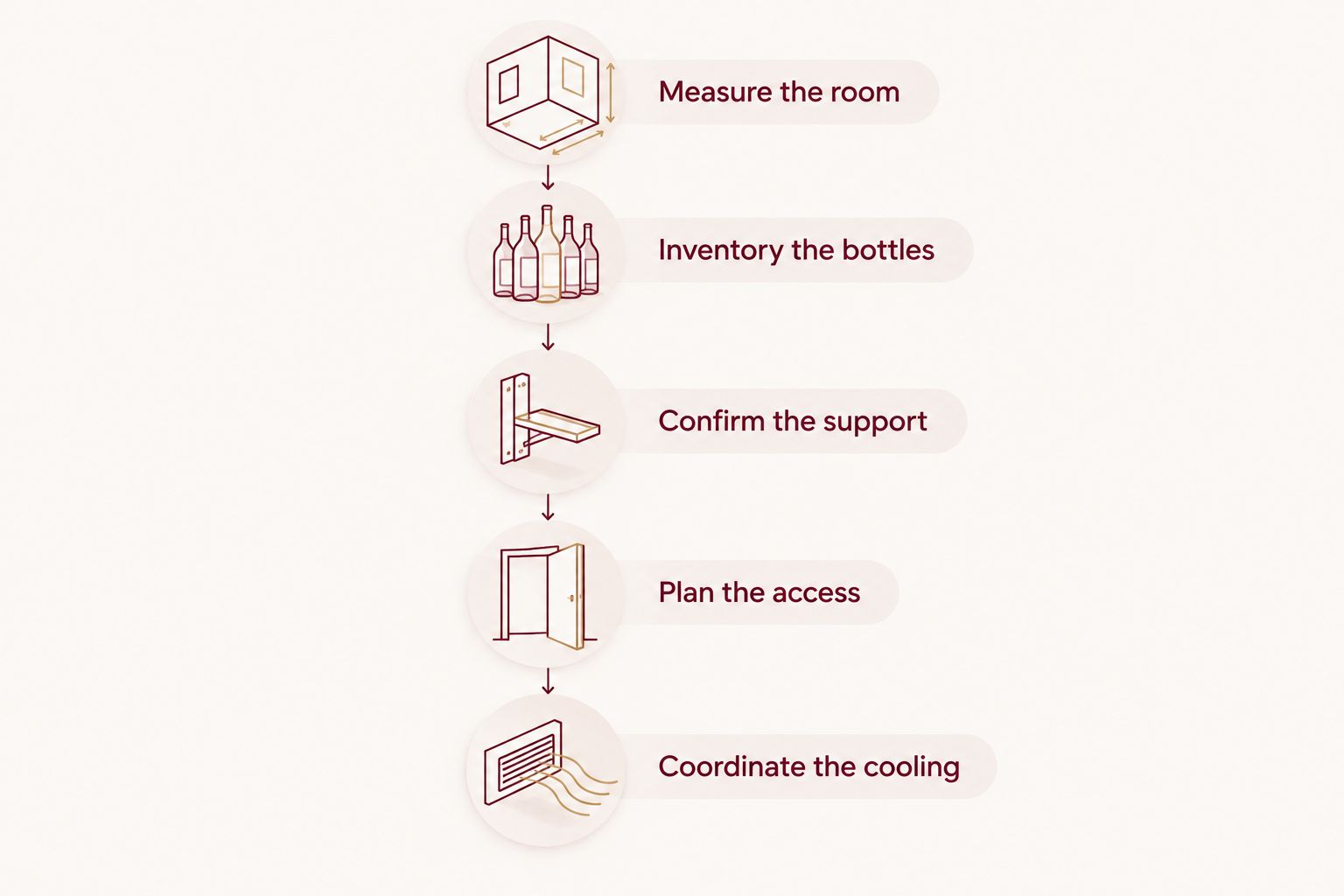
Turn these decisions into written acceptance criteria. A designer should be able to point to the drawing or schedule that answers each one, rather than relying on an informal conversation.
| Brief item | What you should supply | What the proposed design should show |
|---|---|---|
| Room geometry | Finished measurements and obstruction locations | Plan and wall elevations |
| Bottle inventory | Quantities, formats, and representative dimensions | Capacity separated by bottle format |
| Structural support | Known substrates and attachment locations | Mounting method requiring installer confirmation |
| Bottle access | Retrieval preferences and reach needs | Storage depth and circulation space |
| Equipment | Selected models and installation documents | Openings, clearances, and service access |
| Finish direction | Material and finish preferences | Identified selections for approval |
Wall-mounted or floor-to-ceiling racks: specify the support first
Wall-mounted racks and floor-to-ceiling systems solve different attachment problems. Decide which surfaces can support the intended installation before choosing the display arrangement. Neither approach removes the need to verify the structure.
The supplied product information identifies the VintageView Helix HX-FCP-10 as a single-sided, floor-to-ceiling post kit with bottles arranged label-forward around a steel and aluminum-alloy column. The Genuwine Cellars Reserve Label Line single-width rack is identified as a wall-mounted metal, label-forward display. These are useful reference options, not interchangeable installation specifications.
| Rack reference | Best for | Supported design characteristic | Trade-off to resolve |
|---|---|---|---|
| VintageView Helix HX-FCP-10 | Homeowners considering a floor-to-ceiling display | Single-sided post; spiral, label-forward bottle arrangement | Confirm floor and ceiling attachment suitability and bottle fit |
| Genuwine Cellars Reserve Label Line, single width | Homeowners considering a wall-mounted display | Single-width, wall-mounted metal, label-forward arrangement | Confirm wall support, mounting requirements, and bottle fit |
Select the mounting approach that the room can support, then refine the appearance. Neither product should be specified solely from its photograph. The supplied descriptions do not establish every installation dimension, attachment detail, or bottle-format allowance.
These rack options are available through Wine Majesty. Use their product information to frame the design conversation, then obtain the installation requirements for the exact configuration you intend to use.


Display style: describe what you want to see and retrieve
Specify whether labels should face the room, whether bottle necks should face the aisle, and which bottles deserve a dedicated display position. Separate everyday access from presentation. A feature wall and a working collection do not always need the same arrangement.
Your brief should also identify what should remain concealed: cases, packaging, accessories, or equipment. Do not let an attractive reference image decide those requirements by omission.
| Arrangement | Best for | Advantage | Constraint |
|---|---|---|---|
| Label-forward display | Collectors who want visible labels | Shows bottle identity from the room | Verify spacing against actual bottle shapes |
| Neck-forward storage | Collectors who prefer that retrieval orientation | Presents bottles with necks toward the access side | Labels need a separate identification approach |
| Deeper storage | Collectors prioritizing depth within the layout | Uses additional rack depth for storage | Rear-bottle retrieval needs explicit planning |
| Case storage | Collectors retaining original cases | Keeps cases together | Requires dimensions separate from individual-bottle positions |
Record finishes after these decisions. Ask for the selected finish to be identified in the approval documents, and describe which surrounding materials it needs to coordinate with. A finish name alone does not settle bottle access or mounting suitability.
Refrigerator integration: use model dimensions, not category names
If your 2026 wine room includes a refrigerator, identify the exact model before adjacent rack dimensions are approved. Door hinges, handles, ventilation requirements, and service access belong in the brief alongside the appliance body dimensions.
For example, the supplied description for the Allavino VSWR56 dual-zone wine refrigerator lists a body width of 23.4 inches, height of 33.9 inches, and depth of 23.6 inches. Those dimensions are a starting reference, not a finished installation opening. Use the installation documentation to establish required clearances and verify the selected hinge configuration.
This Allavino model is best for a brief considering a compact dual-zone refrigerator alongside racking. It is unsuitable as a substitute for cooling the surrounding wine room: its refrigerated interior and the room are separate storage environments.
Ask the designer to show the appliance with its door open and to identify the removal route for service. Wine Majesty sells both wine refrigerators and cellar cooling systems, so specify which function your project requires rather than requesting cooling as an undefined addition.
Why custom wine rack designs vary
The brief determines what the rack design must accommodate. These factors explain why a layout that suits another collector's room is not automatically suitable for yours:
- Room fit: Finished dimensions, doors, windows, and fixed equipment define the usable storage area.
- Bottle mix: Standard bottles, magnums, and cases require separate fit checks and capacity allocations.
- Mounting surfaces: Walls, floors, and ceilings determine which attachment approaches need verification.
- Retrieval preferences: Storage depth and display orientation change how you identify and remove bottles.
- Cooling coordination: Airflow, equipment openings, and service access restrict where racks belong.
- Future collection: Planned additions affect the balance between current storage and expansion space.
What should you send with a cellar design request?
Send a measured plan, wall photographs, a bottle inventory, and your preferred storage arrangements. Add selected equipment documents and identify any structural information that still requires installer verification.
For a 2026 submission, put a revision date on the brief and keep one current version. Mark measurements as confirmed or awaiting verification, and distinguish requirements from preferences. That prevents an inspirational image from overriding a necessary equipment opening.
Include an approval checklist covering bottle formats, capacity by format, mounting approach, retrieval access, finishes, and equipment clearances. Approve the drawings against this checklist, not just against the rendering.
Can custom wine racks fit magnums and mixed bottle shapes?
Custom wine racks can be designed around magnums and mixed bottle shapes when those formats are specified and checked. A 1.5-liter magnum is not interchangeable with a 750-milliliter standard bottle for rack planning.
Provide representative outside dimensions and the intended quantities for each format. Require the designer to identify which positions accommodate which bottles; a single overall capacity figure is not sufficient.
Should cellar cooling be chosen before the racks?
Choose the cooling approach before finalizing the rack layout. The unit's location, airflow requirements, and service access affect where storage can be installed.
For a 2026 project, review the cooling installation documents and rack drawings together. Do not approve a continuous rack wall where equipment access or airflow still needs to be resolved.
FAQ
What should I include in a custom wine racks design brief?
Include finished room measurements, bottle formats and quantities, mounting surfaces, display preferences, cooling requirements, and access needs. Ask for each requirement to be shown in the drawings or specification schedule.
Do I need to measure every wine bottle?
Provide representative measurements for each bottle shape and size you want the racks to accommodate. Standard 750-milliliter bottles do not all have identical outside dimensions.
Can custom wine racks hold magnums?
Custom wine racks can accommodate 1.5-liter magnums when the design specifies and verifies their fit. Allocate magnum positions separately rather than assuming every standard-bottle position is suitable.
Are wall-mounted racks better than floor-to-ceiling racks?
The better mounting approach is the one compatible with your room's verified structural support and preferred layout. Both require confirmation of attachment details for the selected system.
Do custom wine racks keep wine cool?
Custom wine racks do not regulate temperature. Specify cellar cooling or a wine refrigerator separately and coordinate the rack layout with its installation requirements.
Can I put a wine refrigerator beside custom racks?
A wine refrigerator can sit alongside custom racks when the layout follows its installation requirements. Include door swing, ventilation, service access, and the exact selected model in the brief.
Does Wine Majesty help with custom wine cellar design?
Wine Majesty offers custom wine cellar design services for collectors and homeowners building wine storage spaces. Send room measurements and collection requirements so the design discussion addresses racks and cooling together.
One last thing
Ask for a retrieval check before approving the layout. Have the designer show how you reach a rear bottle, remove an oversized bottle, open the refrigerator, and access cooling equipment. If those actions are unresolved, the room is not ready for final rack approval—regardless of how polished the rendering looks.


