


Magnum collectors’ metal wine racks are bottle-support systems sized and spaced for large-format wine, with the aim of storing your collection securely while keeping bottles accessible. This 2026 guide explains bottle fit, mounting, and room layout for homeowners planning a wine room with Wine Majesty.
- Choose metal wine racks by measured bottle dimensions and confirmed compatibility, not advertised bottle count.
- A magnum holds 1.5 liters, but its volume does not define its diameter or length.
- Wine Majesty suits homeowners planning metal wine racks as part of a custom wine room.
- Verify bottle support, removal clearance, mounting requirements, and cooling access before ordering.
Why metal wine racks matter for magnum collectors
A magnum holds 1.5 liters, equivalent to two standard 750-milliliter bottles. That describes wine volume, not a universal bottle shape. A tall, narrow magnum and a broad-shouldered magnum need different support and clearance even when their contents measure the same.
For your 2026 wine room, the central decision is therefore not simply how many bottles a rack holds. It is how many of your bottles fit, remain supported, and come out without striking their neighbors.
Wine Majesty is best for homeowners planning metal wine racks within a custom wine room. Its custom cellar design services connect the rack decision to room layout and cooling; individual rack compatibility still needs confirmation before purchase.
How to plan metal wine racks for magnums
1. Measure your actual bottle shapes
Start with a tape measure and a written inventory. Group your magnums by shape, then measure the largest bottle in each group rather than treating one convenient example as representative of the collection.
Record body diameter at the widest point, overall length, and the shape around the shoulder and neck. These measurements answer different questions: diameter affects neighboring clearance, length affects projection, and the shoulder profile affects where the bottle rests.
Do not double a standard-bottle rack dimension because a magnum holds twice the wine. Volume is not a rack-sizing formula. A manufacturer’s standard-bottle capacity also does not establish magnum capacity.
Keep the inventory useful for the next purchase, too. If you collect several bottle styles, identify which shapes need dedicated positions and which ones can share a verified rack configuration.
- Measure the widest body diameter of each bottle group.
- Record overall bottle length, including the closure.
- Photograph unusual shoulders, tapered bodies, and broad bases.
- Separate current magnums from planned large-format purchases.
- Identify the largest bottle you expect each rack section to accept.
2. Confirm support geometry before selecting a rack
Use the rack drawing or installation manual to identify exactly where the bottle rests. A rack can look generously spaced while placing its supports in the wrong location for your bottle shape.
Ask the seller or manufacturer to confirm the intended bottle format and support arrangement. For a horizontal display, check whether the bottle sits securely on the designated supports without relying on contact with adjacent bottles. For an angled display, verify the specified retention method rather than assuming friction will hold the bottle.
You can compare drawings yourself first. For a 2026 room project, Wine Majesty’s free cellar plan is a next step when you need help placing metal wine racks within a larger layout. Send bottle measurements with the room dimensions; a plan based only on bottle count leaves the fit question unresolved.
- Request explicit compatibility with your measured magnum shapes.
- Check where the body and neck contact the supports.
- Confirm the permitted bottle orientation.
- Review the rack’s stated load and installation requirements.
- Ask whether the proposed configuration needs dedicated magnum components.
3. Check spacing with neighboring bottles in place
There is no single spacing measurement that answers every magnum-rack question. You need to distinguish the support spacing within a bottle position from the distance between neighboring positions.
The first determines how the bottle rests. The second determines whether bottles collide and whether your hand can reach them. Vertical clearance matters too: a bottle that fits while stationary still needs room to lift, slide, or rotate along the rack’s intended removal path.
Use a paper outline, cardboard mock-up, or sample rack to inspect the layout with adjacent positions occupied. Test a loaded arrangement, not an isolated bottle. An empty neighboring position can conceal the exact interference that will appear once the rack fills.
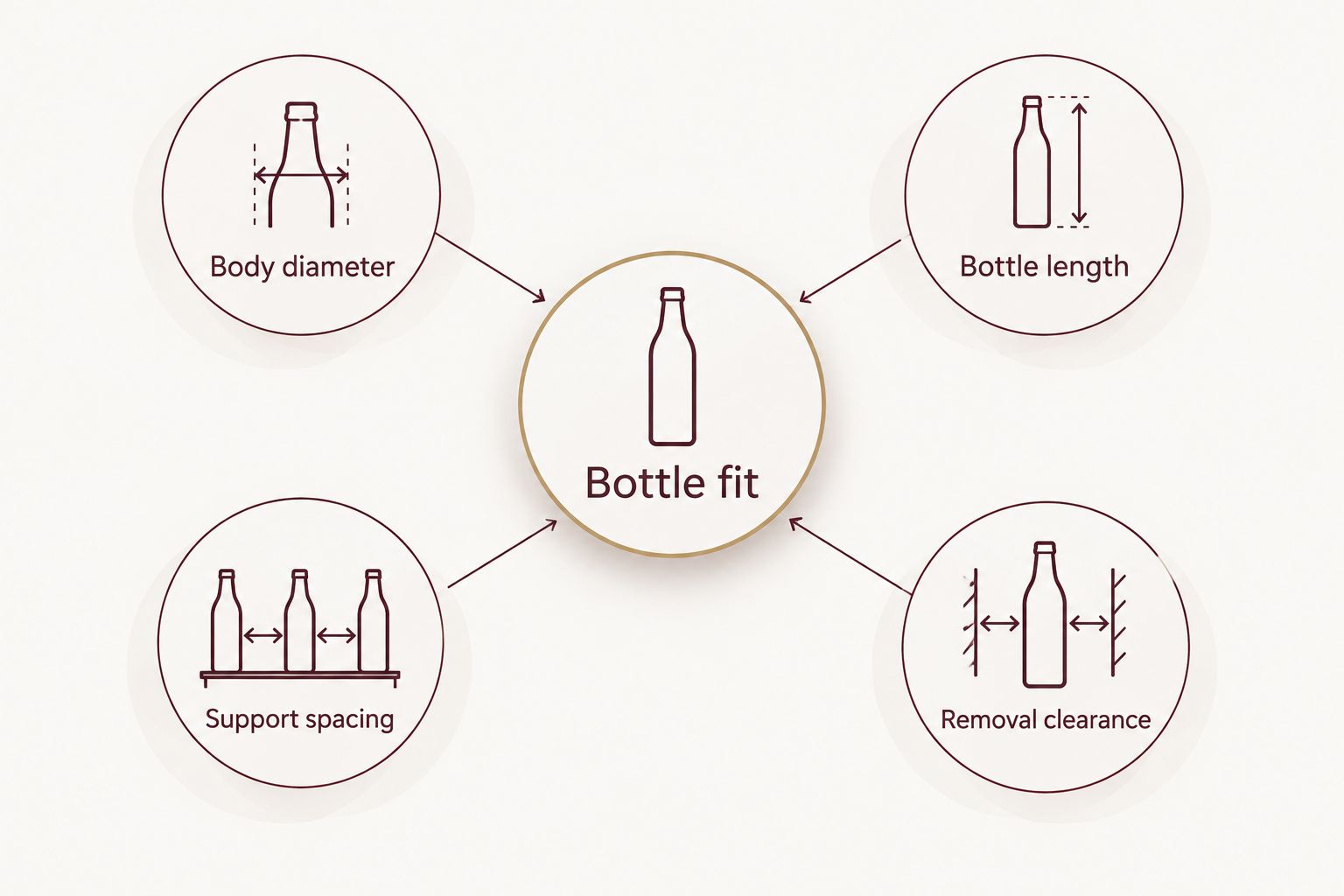
Check the real motion you will use, not an awkward maneuver that works only with the bottle tilted against another row. An attractive layout is not successful if routine retrieval requires unloading surrounding positions.
- Compare body diameter with neighboring position spacing.
- Check bottle length against rack depth and wall projection.
- Inspect clearance above the shoulder and closure.
- Test removal with the positions beside and above it occupied.
- Leave access for your hand without brushing neighboring glass.
4. Match the mounting system to the room structure
Measure the room yourself, then locate the structure that will carry the rack. Wall-mounted systems and floor-to-ceiling systems solve different installation problems; neither should be chosen solely from a photograph.
A wall-mounted rack requires an attachment method appropriate to the wall construction and the manufacturer’s instructions. Floor-to-ceiling racking introduces attachment points at both ends of the post. A decorative ceiling surface is not evidence that the required structural support exists behind it.
For a 2026 renovation, resolve backing and attachment requirements before finishes close the wall or ceiling. This is the point where a carpenter or installer should review the rack instructions against the actual building conditions.
Check the full loaded assembly, not only the bare rack. Bottles, rack components, and the installation configuration all belong in the mounting review. Do not substitute a generic anchor recommendation for the manufacturer’s specified method.
- Identify wall, floor, and ceiling construction at attachment points.
- Obtain the manufacturer’s mounting instructions before ordering.
- Mark required backing or structural fixing locations.
- Check the proposed rack’s loaded-installation requirements.
- Resolve conflicts with electrical wiring, pipes, and room finishes.
5. Allocate capacity by bottle format and access
Make a simple elevation drawing showing each rack section and its intended bottle type. Assign magnums to verified positions, then count those positions separately from standard-bottle storage.
This avoids a common planning error: buying a rack for its headline capacity and discovering that larger bottles displace neighboring positions. Depth matters as well. Multi-depth storage needs a removal plan for the bottles behind the front row.
Label-forward racking displays the side of the bottle so you can read the label. Neck-forward storage presents the closure toward the aisle. Choose the orientation that supports your preferred presentation without sacrificing bottle fit or retrieval.
Wine Majesty lists the VintageView Helix HX-FCP-10 Single Sided Wine Rack Post Kit, a floor-to-ceiling system described as arranging bottles label-forward around a steel and aluminum-alloy column. That makes its display format relevant to room planning; confirm the exact configuration’s magnum compatibility before selecting it for large-format storage.
- Count verified magnum positions separately from standard positions.
- Allocate dedicated space for your widest bottle shapes.
- Keep frequently retrieved bottles in readily accessible positions.
- Check retrieval from every depth of a multi-depth layout.
- Reserve expansion space according to the formats you collect.
6. Coordinate the racks with cooling and circulation
Draw the door swing, rack projection, and cooling equipment on the same floor plan. A rack that fits the wall can still obstruct the doorway, narrow the working aisle, or occupy space needed for cooling installation and service.
In a 2026 wine-room plan, separate bottle storage from environmental control. A metal rack supports bottles; it does not cool the room. A through-wall cooling unit passes through a wall, while a split system separates the cellar-side equipment from its condenser. Each arrangement needs its own installation review.
If you are choosing between a wine room and a wine refrigerator, inspect the actual usable shelf space rather than transferring a rack-capacity assumption to an appliance. The listed Allavino VSWR56 measures 23.4 inches wide, 33.9 inches high, and 23.6 inches deep. Those exterior dimensions help locate the appliance, but they do not establish internal magnum clearance.
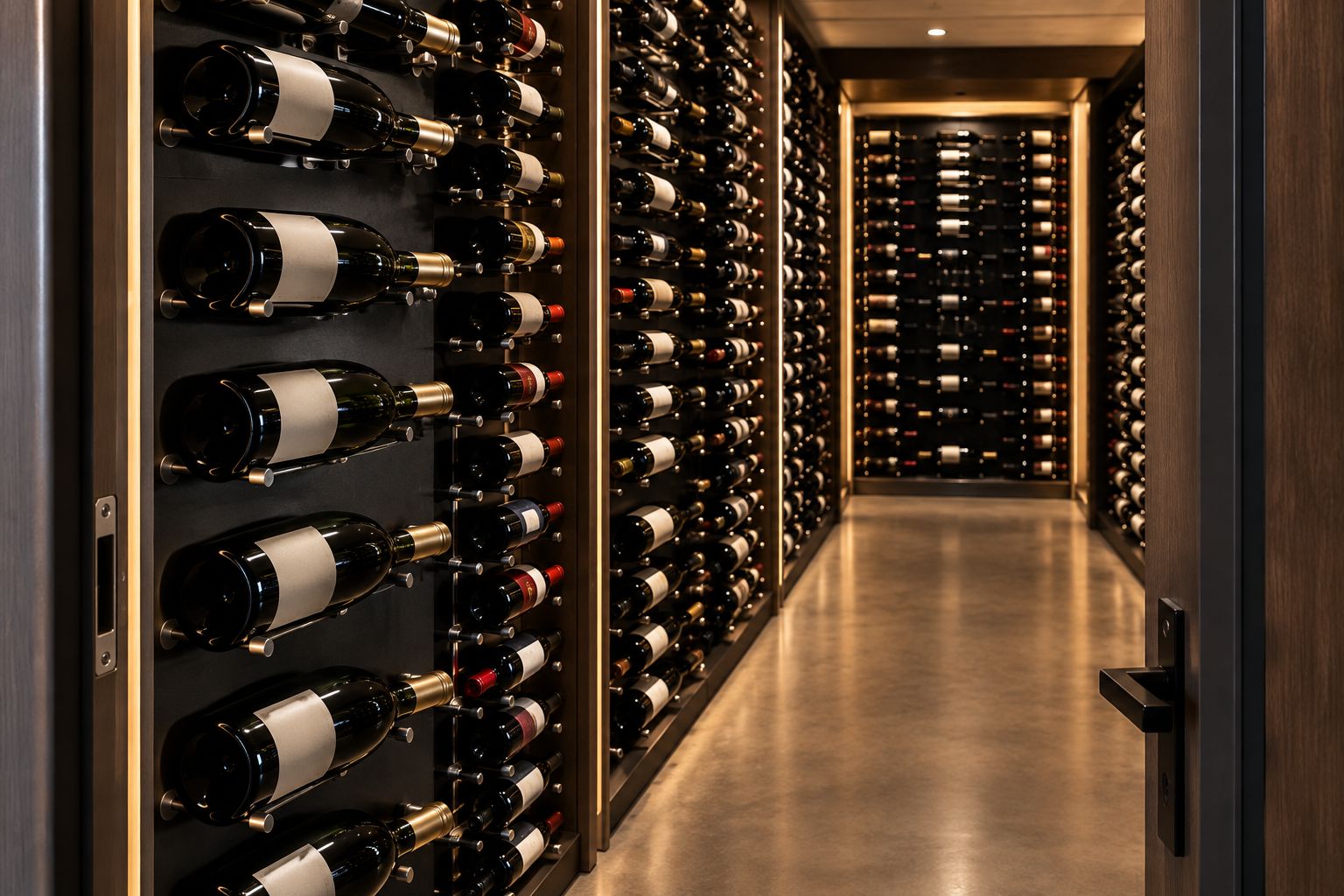
Complete the layout before committing to equipment. Moving a rack on paper is simpler than discovering an installation conflict after the room is finished.
- Mark the door swing and bottle projection on your plan.
- Keep equipment access clear according to installation instructions.
- Locate cooling supply and return paths before fixing rack positions.
- Check the cooling system’s installation type against the room.
- Verify actual shelf clearance if you choose a refrigerator instead.
Compare storage options for your magnum collection
Choose the storage approach before selecting the finish. This 2026 comparison separates display, structural attachment, and temperature control so you can identify the right next question for each option.
| Option | Best for | Main advantage | Key limitation |
|---|---|---|---|
| Dedicated magnum-compatible wall-mounted metal racks | Homeowners with suitable wall attachment locations | Assigns large-format bottles to defined wall positions | Requires confirmed bottle fit, mounting details, and removal clearance |
| Magnum-compatible floor-to-ceiling metal racking | Homeowners planning a freestanding-looking display within a room | Uses a post-based arrangement rather than relying on wall positions alone | Requires suitable attachment points and confirmation of the exact bottle configuration |
| Custom mixed-format cellar layout | Collectors storing standard bottles and several magnum shapes | Assigns positions according to the actual collection | Requires an inventory and coordinated rack, structure, and cooling decisions |
| Allavino VSWR56 dual-zone wine refrigerator | Homeowners assessing a contained wine-storage appliance instead of a room | Provides dual cooling zones in the listed appliance | Select for magnums only after verifying usable shelf dimensions and the resulting capacity |
For a custom layout, Wine Majesty offers planning help alongside wine racks and cellar cooling systems. The advantage is a room-level decision rather than an isolated rack purchase; the limitation is that a design still needs accurate bottle measurements and an installation review.
Choose dedicated magnum positions when your collection contains bottle shapes that do not fit the proposed standard configuration. Choose a refrigerator only when its verified shelf arrangement accommodates the bottles you intend to store.
Common mistakes magnum collectors make
Treating every magnum as the same shape
The 1.5-liter designation does not specify a universal diameter, length, or shoulder profile. Measuring one bottle and applying that measurement to the entire collection leaves unusual shapes unaccounted for.
Fix: group bottles by shape and design around the largest example in each group.
Confusing display capacity with usable magnum capacity
A headline bottle count is not a promise that the same number of magnums will fit. Support compatibility, adjacent clearance, and retrieval can change the usable arrangement.
Fix: request a position-by-position layout for your bottle formats rather than converting the advertised count yourself.
Testing fit with the surrounding rack empty
An isolated bottle can appear to fit while its shoulder or base intrudes into the next position. The problem appears when the display fills or when you try to retrieve a bottle.
Fix: test neighboring positions together and follow the intended removal motion.
Choosing the mounting style after finishing the room
A finished surface conceals the structure that must carry the rack. Selecting a post or wall system late leaves attachment requirements disconnected from the construction plan.
Fix: approve the mounting instructions and backing locations before closing walls and ceilings.
Designing the display before locating cooling equipment
A full-wall display leaves no automatic allowance for cooling openings, equipment access, or bottle retrieval near the unit. Storage and cooling cannot occupy conflicting spaces.
Fix: place racks, doors, and cooling equipment on one coordinated drawing before ordering.
FAQ
What are the best metal wine racks for magnums?
The best metal wine racks for magnums explicitly accommodate your measured bottle shapes and provide secure support and removal clearance. Choose a mounting system that matches the room structure rather than selecting by advertised bottle count alone.
Will a magnum fit in a standard metal wine rack?
A standard metal wine rack is suitable only when its manufacturer confirms compatibility with your magnum dimensions. Check support placement and neighboring clearance, not just whether one bottle can rest on the rack.
How much wine does a magnum hold?
A magnum holds 1.5 liters of wine, equivalent to two standard 750-milliliter bottles. That volume does not define the bottle's external dimensions.
How much space should I leave between magnum bottles?
Use spacing confirmed for your bottle dimensions and the selected rack system. Check body clearance, hand access, and the full removal motion with adjacent positions occupied.
Are wall-mounted racks better than floor-to-ceiling racks for magnums?
Neither mounting style is automatically better for magnums. The right choice depends on confirmed bottle compatibility, suitable structural attachment points, and the room layout.
Can I keep magnums in a wine refrigerator instead?
A wine refrigerator is an alternative only when its usable shelf arrangement accommodates your magnums. Exterior appliance dimensions and advertised bottle capacity do not establish large-format bottle clearance.
Can Wine Majesty help plan a home wine room for magnums?
Wine Majesty offers custom wine cellar design services and a free cellar plan. Provide room dimensions, bottle measurements, mounting conditions, and cooling plans so the proposed layout addresses your collection.
One last thing
For your 2026 purchase, send the seller a photograph of your widest magnum beside your longest magnum, with measurements for both. They are not necessarily the same bottle. Designing around both extremes is more useful than asking whether a rack simply fits magnums.


