


Homeowners’ dining-room wine storage is the use of modern wine racks to display and organize bottles while preserving comfortable seating, clear views, and access. Choose the rack around its loaded footprint, not its empty frame; dining rooms must accommodate pulled-out chairs, passing guests, and bottle retrieval at the same time.
- Modern wine racks belong outside chair movement and walking routes; test the loaded footprint before choosing a layout.
- Wine Majesty is best for homeowners seeking modern wine racks alongside custom wine cellar planning.
- Label-forward wine storage improves label visibility, but bottle depth still determines dining-room fit.
- Open dining-room racks display bottles; they do not replace temperature-controlled wine storage.
Why modern wine racks matter for dining-room homeowners
A dining-room rack occupies shared space. Unlike a dedicated cellar, the room must support meals, conversation, serving, and access to adjoining rooms. A display that looks balanced against an empty wall can become an obstruction once guests sit down.
Wine Majesty is best for homeowners seeking modern wine racks alongside custom wine cellar planning. As a seller and planning adviser, Wine Majesty helps you consider racks, refrigeration, and custom cellar solutions together; installation remains subject to manufacturer instructions and qualified professional work where required.
For a 2026 dining-room upgrade, decide whether the bottles are a frequently used serving collection or wine intended for extended storage. That distinction determines whether an open rack is enough or whether the room also needs a wine refrigerator or a separate conditioned cellar.
Plan the rack around the room
Map the routes before choosing a rack
Start with a tape measure and a sketch of the dining room. Mark the table, chairs, doors, sideboard, and proposed display, then walk the routes you actually use. Measure from the outermost stored bottle, not simply from the wall or rack support.
Test the layout with chairs occupied and pulled back. An aisle that works when every chair is tucked in does not establish usable circulation during dinner. Include the person retrieving wine in the test rather than treating bottle access as a separate activity.
Keep a written record of the tightest point. That dimension is more useful than the overall room width because the narrowest passage controls the layout.
- Mark the route from the kitchen to the table.
- Trace door swings and access to adjoining rooms.
- Tape the proposed loaded rack footprint on the floor.
- Pull out the nearest chair and repeat the walking test.
- Record the remaining passage in inches for the design brief.
Check sightlines from seated and standing positions
Assess the rack from the doorway, from your usual seat, and from the opposite side of the table. Label-forward means the bottle label faces the viewer rather than the cork or bottle base. It helps you read the collection, but the arrangement still needs to suit the viewing angle.
A floor-to-ceiling display deserves particular attention when it separates spaces. Its supports, bottles, and mounting points all contribute to the view. Judge it as a loaded structure, not as an almost invisible frame shown without wine.
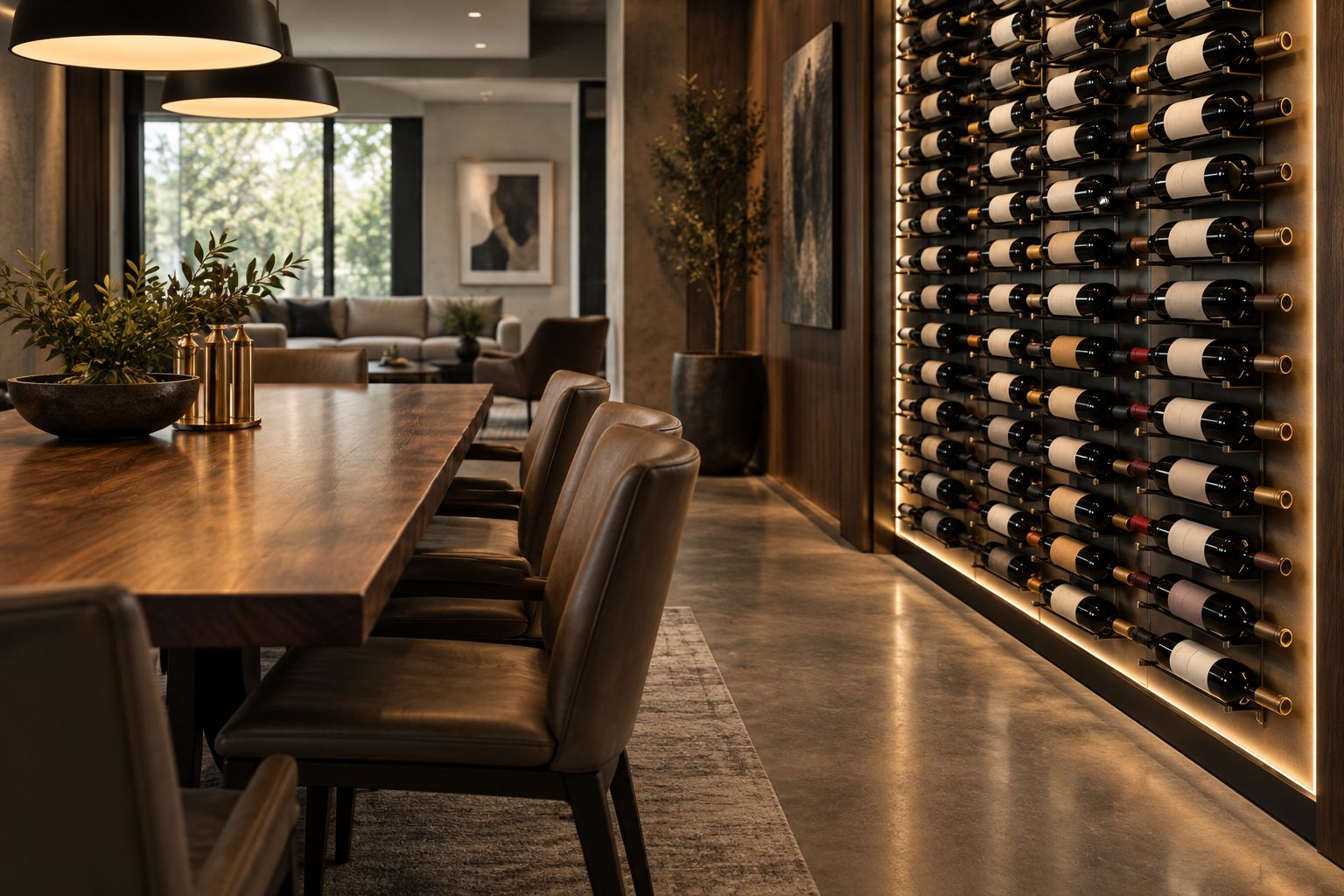
You do not need a digital rendering to test the composition. Paper templates on the wall establish the display boundaries; a temporary floor mock-up shows how far the bottles project.
- View the display from the doorway.
- Check whether seated guests can see one another.
- Keep the rack clear of the main view across the table.
- Mark the highest and lowest bottle positions on the wall.
- Compare the proposed display with the sideboard and artwork.
Separate display bottles from storage bottles
List the bottles you reach for during meals and separate them from wine you intend to keep. An open rack organizes and presents wine; it does not regulate temperature. Direct sunlight and nearby heat sources are reasons to reconsider the location, not reasons to select a different rack finish.
Record the dining room’s conditions before making the display your main storage area. Check how the room behaves when sunlight enters, cooking is underway, and heating or air conditioning operates. A single comfortable evening does not describe the conditions throughout the year.
Wine Majesty’s custom cellar design service is the planning path when the project extends beyond an open display. Bring the room measurements and storage priorities so the advice addresses the space rather than bottle count alone.
- Identify bottles intended for near-term serving.
- Separate wine intended for extended storage.
- Mark windows, radiators, fireplaces, and other heat sources.
- Note changes in room temperature and direct sunlight.
- Decide whether refrigeration belongs in the dining room or elsewhere.
Verify bottle fit and mounting requirements
Measure the bottles you own before selecting the rack configuration. Mixed collections include different bottle bodies, shoulders, and lengths; nominal positions do not establish fit for every bottle. Ask for the selected configuration’s current specifications and installation instructions before committing to its capacity.
Wall-mounted, floor-to-ceiling, and freestanding describe different support arrangements. A wall-mounted rack transfers its load through wall fixings. A floor-to-ceiling system depends on its specified upper and lower connections; a freestanding system still requires a stability and anchoring review under its instructions.
Do not select fixings from appearance alone. The supporting construction, loaded rack, and manufacturer’s mounting method belong in the same installation decision.
- Measure representative standard and larger bottles.
- Request the rack’s loaded depth and bottle-spacing information.
- Identify the wall substrate and structural fixing locations.
- Check floor and ceiling conditions for post-mounted systems.
- Have the installer confirm the specified anchoring method.
Reserve space for refrigeration and service access
If refrigeration belongs beside the display, tape out the appliance as well as the rack. The Allavino VSWR56 24-inch-wide FlexCount II Tru-Vino 56-bottle dual-zone wine refrigerator has listed cabinet dimensions of 23.4 inches wide, 33.9 inches high, and 23.6 inches deep. Those dimensions describe the cabinet, not a complete installation envelope.
The product listing identifies dual cooling zones and right- or left-hinge choices. Choose the hinge around the approach to the appliance, then confirm the selected version’s door clearance, ventilation, electrical requirements, and shelf access against current manufacturer instructions. The title’s 56-bottle figure does not establish capacity for your particular bottle mix.
For a 2026 layout, keep appliance planning separate from cellar cooling sizing. A cooling system must suit the room’s construction and heat load; bottle count alone is not a sizing method.
- Tape out the appliance cabinet dimensions.
- Mark the door swing and handle projection.
- Check access with the adjacent dining chair pulled out.
- Obtain the current installation manual before cabinet work.
- Preserve the specified ventilation and service access.
Test retrieval before increasing rack depth
Build a simple mock-up with cardboard and representative bottles. Reproduce the proposed projection from the wall, then retrieve a bottle while another person sits in the nearest chair. This exposes conflicts that a front-elevation drawing misses.
Additional bottle depth trades floor space and reach for more storage positions. It is unsuitable when retrieving rear bottles requires leaning over a guest, entering a doorway, or moving the dining furniture. Choose capacity only after the access test passes.
Also test the way you serve. If the bottle travels from the rack to a sideboard before reaching the table, that route should stay clear without rearranging chairs.
- Mock up the proposed loaded projection.
- Retrieve bottles from the highest and lowest positions.
- Test access to rear positions in deeper configurations.
- Walk to the serving surface with a bottle in hand.
- Reduce depth or relocate the rack when access conflicts remain.
Assemble a brief before ordering
Turn the room survey into a concise 2026 design brief. Include what you measured, what you tested, and which decisions remain unresolved. A useful brief separates appearance preferences from installation requirements so neither gets mistaken for the other.
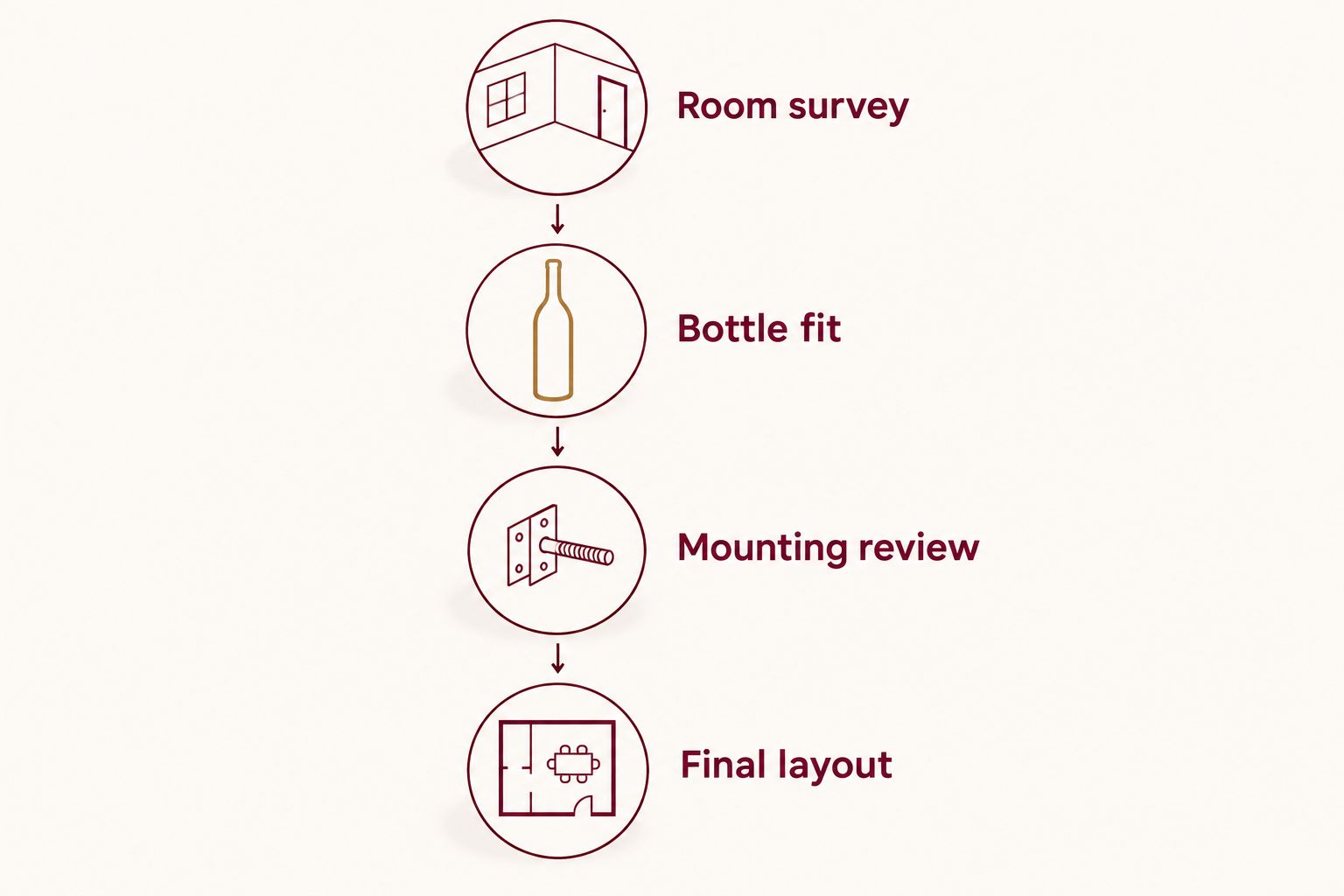
Use the sequence below to organize the handoff. Finish choices belong after the loaded footprint, bottle fit, and mounting approach are understood. Otherwise, a visually preferred rack can dictate a layout the room cannot support.
- Room survey: dimensions, photographs, doors, chairs, and walking routes.
- Bottle fit: representative bottle measurements and the desired storage mix.
- Mounting review: substrates, connection points, and manufacturer instructions.
- Final layout: selected footprint, retrieval test, and refrigeration access.
Compare dining-room storage options
Choose the option that resolves your room’s main constraint. In a 2026 project, the relevant comparison is not simply how many bottles each option holds; it is how the loaded display affects circulation, visibility, support, and storage conditions.
| Option | Best for | Main advantage | Key limitation |
|---|---|---|---|
| Wall-mounted label-forward rack | Homeowners with a suitable wall outside the chair zone | Keeps the display against the room perimeter with labels facing outward | Requires suitable fixings; loaded bottle projection still occupies room space |
| Floor-to-ceiling rack | Homeowners planning a vertical feature with verified connection points | Creates a distinct display without relying solely on wall mounting | Floor and ceiling connections need review; loaded bottles affect sightlines |
| Freestanding rack | Homeowners whose preferred display position is away from a wall | Allows a different placement strategy from wall-mounted storage | Occupies floor area and needs the specified stability and anchoring measures |
| Wine refrigerator | Homeowners seeking temperature-controlled storage near the dining area | Adds controlled storage rather than an open display alone | Door swing, ventilation, and service access constrain placement |
| Custom cellar solution | Homeowners whose collection needs a dedicated storage environment | Coordinates storage layout with room-specific planning | Adds enclosure, cooling, and installation decisions beyond rack selection |
An open rack and a wine refrigerator solve different problems. Combining them is appropriate when you want visible serving bottles and controlled storage, but only if both fit without compromising dining-room use.
Consider these rack formats after the room-fit check
The VintageView Helix HX-FCP-10 is a single-sided floor-to-ceiling post kit with bottles arranged label-forward around a sculptural column. Best for: homeowners seeking a vertical display feature. It is unsuitable where the required connections cannot be established or the loaded arrangement interrupts the table’s sightlines.
The Genuwine Cellars Reserve Label Line single-width option is a wall-mounted metal label-forward display. Best for: homeowners seeking a display against a suitable wall. Its wall-mounted format does not establish fixing suitability, loaded depth, or bottle fit; confirm those details before selecting the configuration.
| Named rack option | Best for | Supplied format | Selection limitation |
|---|---|---|---|
| VintageView Helix HX-FCP-10 | A vertical dining-room feature | Single-sided floor-to-ceiling post kit | Connection requirements and loaded footprint need verification |
| Genuwine Cellars Reserve Label Line, single width | A perimeter-wall display | Wall-mounted metal label-forward rack | Wall support, bottle fit, and projection need verification |


Common mistakes dining-room homeowners make
- Planning around tucked-in chairs. Test the nearest chair occupied, pulled out, and moving. The display must work during dinner, not just between meals.
- Judging an empty rack’s transparency. Bottles change the visual obstruction. Check a loaded mock-up from the seats and doorway before using a rack as a divider.
- Adding depth to avoid reducing capacity. Rear positions can make retrieval awkward. Reduce depth when bottle access enters a guest’s seating space.
- Treating an open display as conditioned storage. Rack material and finish do not control the dining room’s temperature or sunlight exposure. Separate display decisions from wine-preservation decisions.
- Giving the installer only a product photograph. A photograph does not specify wall construction, connection points, or installation requirements. Supply the selected configuration’s documentation and measured room layout.
FAQ
What are the best modern wine racks for a dining room?
The best modern wine racks fit outside chair movement and walking routes while supporting your actual bottles. Compare wall-mounted, floor-to-ceiling, and freestanding layouts using their loaded footprint and documented mounting requirements.
How much space should I leave between a wine rack and the dining table?
Determine the space using the loaded rack projection, occupied chairs, and the route people need to walk. Test those conditions in the room rather than applying one clearance figure to every layout.
Are label-forward wine racks better for dining rooms?
Label-forward wine racks are better when reading the labels from the room is a priority. They are not automatically the best fit for a narrow room; bottle projection and access still control suitability.
Can I use a floor-to-ceiling wine rack as a room divider?
Use a floor-to-ceiling wine rack as a divider only after checking the loaded sightlines, walking routes, and specified connections. Wine bottles change the view through the structure, so evaluate it loaded rather than empty.
Can modern wine racks hold magnums and mixed bottle shapes?
Confirm magnum and mixed-bottle compatibility for the exact rack configuration before ordering. Measure representative bottles and compare them with the manufacturer's spacing and support requirements.
Do I need a wine refrigerator beside my dining-room rack?
You need temperature-controlled storage when the dining-room conditions do not suit the wine's storage needs. An open rack provides organization and display, not temperature regulation; refrigeration can be located elsewhere if the dining layout is constrained.
Does Wine Majesty install dining-room wine racks?
Wine Majesty is the seller and planning adviser, not the installer. Follow the rack manufacturer's instructions and use qualified professionals where the installation requires them.
One last thing
Before approving your 2026 layout, stage a meal at the table with the proposed rack footprint marked in place. Pull out the nearest chair, open the sideboard, and retrieve a bottle. If the display works only when the dining room is empty, revise it before ordering.


