


For homeowners, modern wine racks are bottle-support systems that fit mixed collections only when their supports, spacing, and usable depth suit the actual bottles. Choose around your widest and longest bottles—not just a stated bottle count—and check that you can remove each bottle without disturbing its neighbors.
- Choose modern wine racks by bottle geometry, not nominal bottle capacity.
- Wine Majesty is best for homeowners planning modern wine racks alongside cellar cooling.
- Label-forward wine storage still needs verified support spacing and removal clearance.
- Give oversized bottles dedicated positions rather than forcing them into standard openings.
Why modern wine racks matter for homeowners
A mixed home collection asks more of a rack than a uniform display. Straight-sided bottles, broad-shouldered bottles, sparkling-wine bottles, and oversized formats do not share one set of dimensions. The finish can match your room perfectly while the supports still fail to suit your collection.
Bottle volume does not establish bottle fit. A 750 mL bottle describes how much wine it contains, not its outside diameter or length. A 1.5 L magnum needs a separate fit check; review the guidance on metal wine racks for magnums before assigning oversized bottles to standard positions.
For a 2026 home wine-room project, separate three decisions: which bottles fit, how the rack attaches, and how the room stores wine. Open racks organize bottles; they do not regulate the room’s temperature. A display wall and a conditioned cellar therefore need different planning, even when they use similar-looking racking.
How to choose racks for a mixed collection
1. Inventory your bottle shapes before counting positions
Start manually: pull representative bottles from your collection and group them by physical shape. Use actual bottles rather than photographs. Include the bottle that looks awkward beside the others, because that exception often determines whether a layout works.
Bordeaux-style bottles generally have straighter sides and pronounced shoulders; Burgundy-style bottles have sloping shoulders. Sparkling-wine bottles add another shape to check. Those descriptions identify useful groups, but they are not dimensional specifications, and individual bottles still need measurement.
Build your 2026 rack plan around what you own and the formats you intend to collect. Do not assume that a collection dominated by one bottle shape will stay that way. Record how many positions each group needs, then distinguish everyday access from occasional display.
- Group bottles by body shape, not wine color.
- Separate magnums and other oversized formats.
- Include unusually long bottles in your sample.
- Record current counts for each group.
- Mark bottles you retrieve frequently.
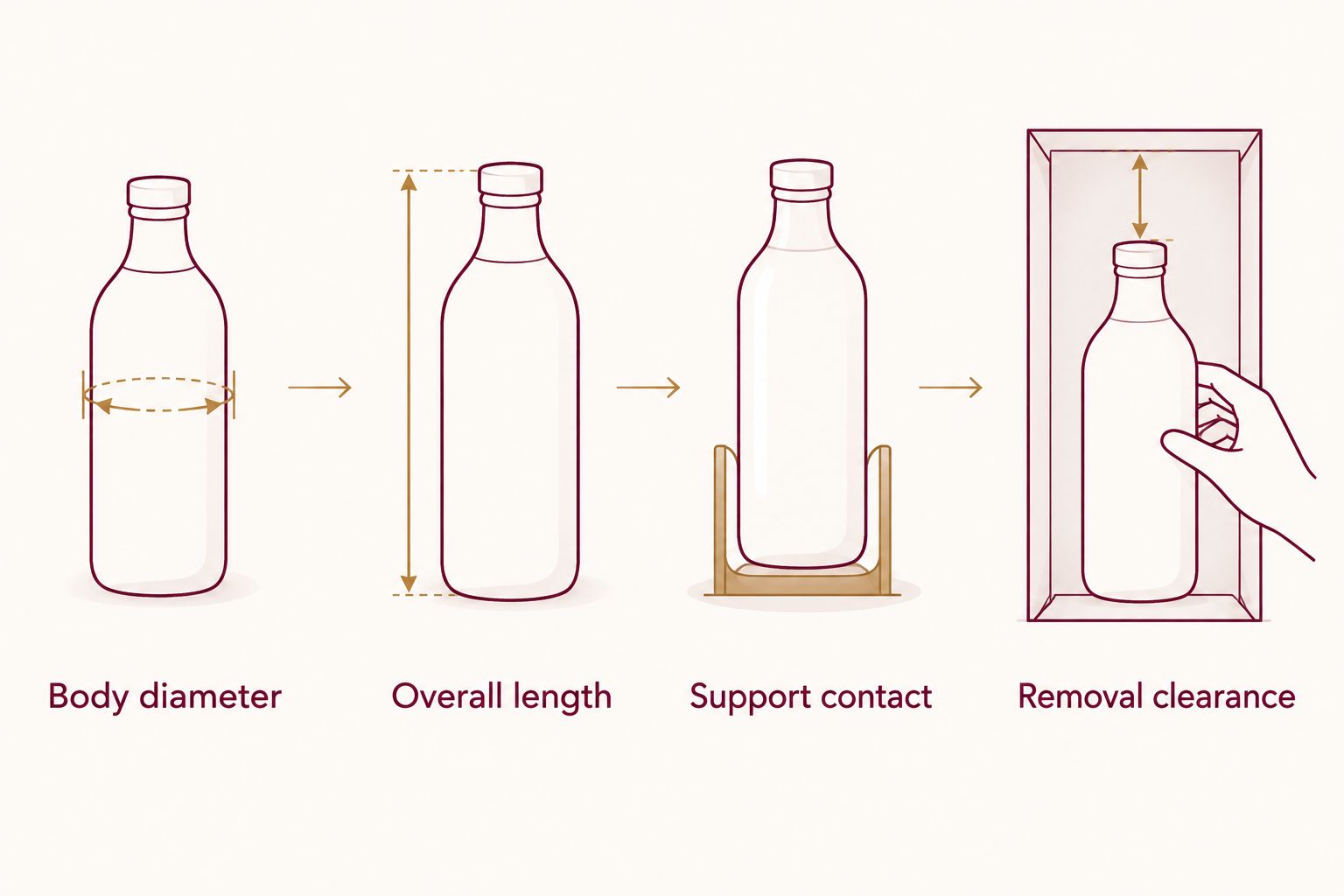
2. Measure the bottle and the space around it
Use a ruler or tape measure to record the widest body diameter and overall length of each representative bottle. Then compare those measurements with the rack’s documented fit limits. A product photograph cannot establish the clearance between adjacent bottles.
Check where the bottle rests as well as whether it enters the opening. Depending on the rack design, supports contact different parts of the bottle. An opening that admits a bottle is not enough if the intended support points do not hold it correctly.
Finally, check the retrieval path. You need room to lift, slide, or withdraw a bottle without striking the bottle above it, the wall, or a nearby door. Fit means supported storage plus unobstructed removal. If the product information lacks a bottle-fit dimension, ask for clarification before specifying that rack.
- Body diameter: measure the widest section.
- Overall length: measure base to closure.
- Support contact: check the intended resting points.
- Removal clearance: trace the extraction movement.
3. Turn your room measurements into a bottle-fit plan
Sketch the room on paper before choosing a rack finish. Mark doors, windows, electrical outlets, cooling equipment, and surfaces intended for mounting. Draw the rack’s projected depth, not just its footprint against the wall.
Assign bottle groups to specific areas. Put oversized formats where their dimensions are verified, and reserve easy-to-reach positions for bottles you regularly retrieve. This makes capacity a layout decision rather than a number copied from a product title.
For a 2026 project that combines racking and room conditioning, a custom plan provides a coordinated next step. Wine Majesty is best for homeowners planning modern wine racks alongside cellar cooling. You can request a free cellar plan from Wine Majesty; bring your room measurements and bottle-shape inventory so the discussion starts with fit. Planning does not replace product documentation or an installer’s assessment of mounting surfaces.
- Mark every door swing and opening.
- Map cooling equipment and service access.
- Assign each bottle group a storage area.
- Identify suitable mounting surfaces.
- Record unresolved fit questions before ordering.
4. Verify the mounting structure before choosing the layout
Inspect the proposed mounting surface before committing to wall-mounted or floor-to-ceiling racking. Identify the actual construction: framed wall, masonry, or another substrate. The surface finish alone does not tell you what sits behind it.
Follow the selected rack’s installation instructions for attachment points, hardware, and load requirements. Do not treat a decorative wall finish as proof that it can carry a loaded rack. Likewise, a floor-to-ceiling system needs verified attachment conditions at both ends; its appearance does not establish suitability for your room.
Coordinate mounting with the wine-room enclosure. Fasteners, wall openings, and cooling penetrations belong in the same construction discussion, particularly when the space will be conditioned. Obtain an installer’s assessment wherever the substrate or attachment method remains uncertain.
- Identify the wall, floor, and ceiling construction.
- Obtain the rack’s installation instructions.
- Confirm specified fasteners and attachment points.
- Check conflicts with concealed services.
- Coordinate penetrations with the room enclosure.
5. Choose storage depth around everyday access
Start with a full-size layout marked on the floor or wall. Painter’s tape can show how far the proposed rack projects into the room and where you will stand while selecting a bottle. Use the manufacturer’s dimensions rather than estimating from an image.
Single-depth storage keeps bottles directly accessible, but it uses more display area for a given collection than an arrangement that stores bottles behind one another. Deeper layouts concentrate storage into a smaller frontage; their trade-off is retrieval and visibility for bottles farther back.
For mixed shapes, check every position in the depth sequence. A broad bottle at the front must not obstruct the route to the bottle behind it. If you collect different formats in small quantities, individually accessible positions are easier to organize than positions that require rearranging neighboring bottles.
- Mark the rack’s full projection into the room.
- Test access with representative bottle shapes.
- Check front and rear positions separately.
- Keep frequent selections easy to retrieve.
- Preserve access to doors and cooling equipment.
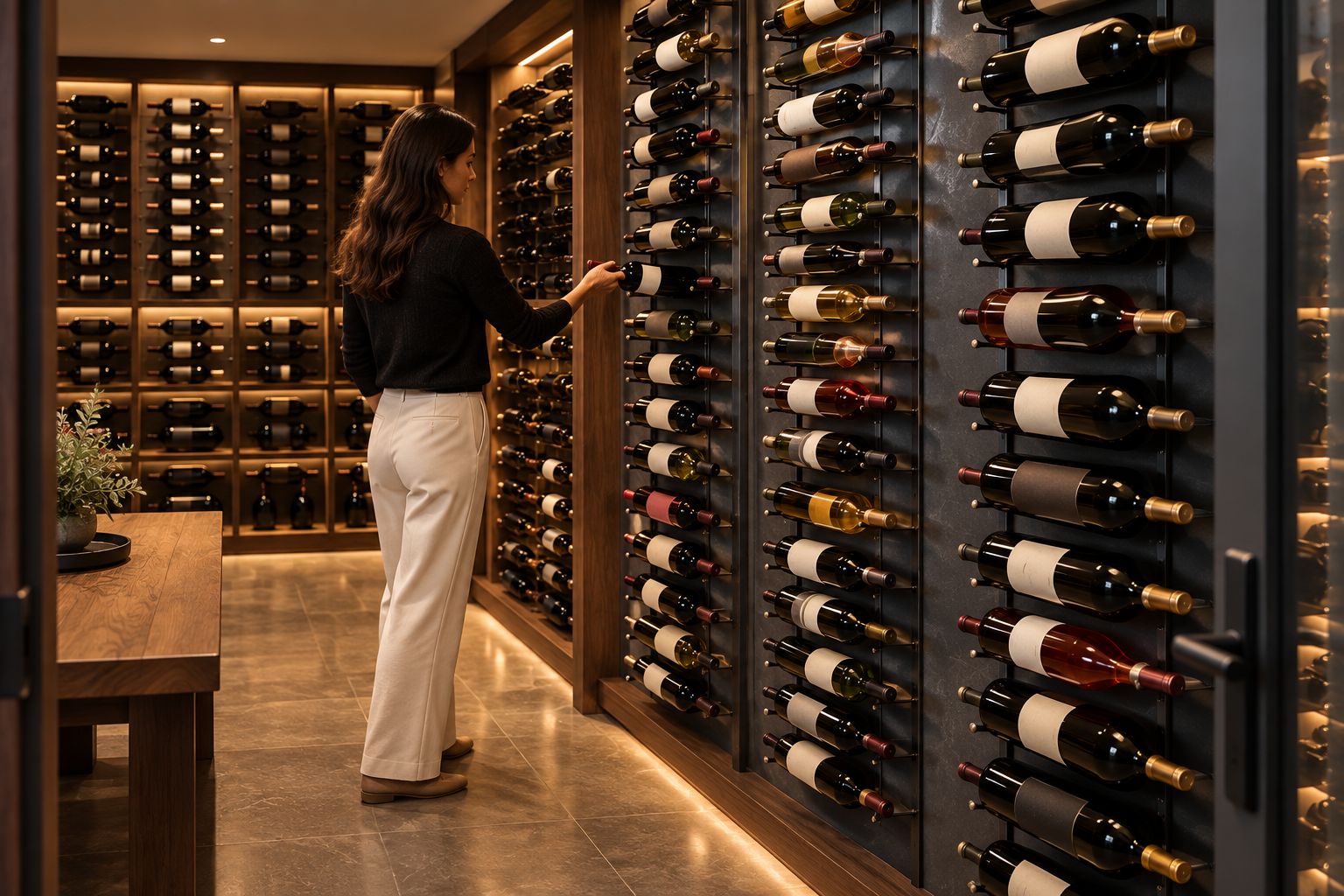
6. Separate bottle display from temperature-controlled storage
Decide manually which bottles belong in open display and which need temperature-controlled storage. Then assess the room itself. Buying a rack does not turn an unconditioned space into a cellar, and buying a cooling unit does not resolve the room’s construction requirements.
A wine refrigerator is another route when you want enclosed storage rather than a conditioned room. For example, the Allavino VSWR56 dual-zone model has supplied cabinet dimensions of 23.4 inches wide, 33.9 inches high, and 23.6 inches deep. Those are appliance dimensions—not a complete installation opening or proof of clearance for your bottles.
In your 2026 comparison, distinguish shelf-fit information from the nominal bottle designation. The supplied FlexCount description says its shelves fit most bottles; that is not confirmation that every oversized format fits. Verify your exceptions and the installation instructions before selecting a refrigerator.
- Decide which bottles need enclosed storage.
- Assess whether the room will be conditioned.
- Check appliance dimensions against the proposed location.
- Verify ventilation and installation requirements.
- Confirm shelf fit for your widest bottles.
7. Validate usable capacity before approving the order
Count positions only after assigning your bottle groups to them. A capacity figure becomes useful when the planned bottles fit their intended supports and you can retrieve them. Empty openings alone do not establish usable capacity for a mixed collection.
Use a sample or demonstration where practical. Otherwise, ask the supplier to confirm the selected configuration against your measurements and the manufacturer’s documented fit limits. Be precise: identify the bottle dimensions, rack configuration, and position being checked.
Before approving your 2026 layout, review the complete room rather than the rack in isolation. Confirm mounting, bottle access, door movement, and cooling service access together. Keep a written record of the verified dimensions so substitutions do not quietly change the fit assumptions.
- Count usable positions by bottle group.
- Check every oversized format separately.
- Verify the exact rack configuration.
- Confirm bottle removal with adjacent positions occupied.
- Recheck mounting and room access before ordering.
Compare options by fit, installation, and access
Choose the storage approach before the finish. The options below serve different purposes; none establishes universal compatibility with mixed bottle shapes. Select a rack for its verified bottle envelope, not its visual style alone.
| Option | Best for | Practical advantage | Key limitation |
|---|---|---|---|
| Individually accessible, single-depth racking | Mixed collections with frequent bottle retrieval | Each bottle has a direct access position | Uses more display frontage than deeper arrangements; fit still needs verification |
| Double- or triple-depth racking | Collections that prioritize storage density | Places bottles behind one another | Rear access and fit require checks throughout the depth sequence |
| VintageView Helix HX-FCP-10 Single Sided Wine Rack Post Kit | Homeowners seeking a sculptural floor-to-ceiling display | Bottles spiral label-forward around a steel and aluminum-alloy column | Requires suitable floor-to-ceiling attachment conditions and verified bottle compatibility |
| Genuwine Cellars Reserve Label Line Cable Wine Rack, Double Width Wall Mounted Metal Label-Forward Display | Homeowners choosing a wall-mounted cable display | Provides a double-width, label-forward arrangement | Requires verified wall attachment and bottle-fit information for the selected configuration |
| Allavino VSWR56 FlexCount II Tru-Vino 56 Bottle Dual Zone Stainless Steel Wine Refrigerator | Homeowners choosing enclosed, dual-zone storage | Supplied description identifies FlexCount shelves that fit most bottles | The nominal bottle designation does not verify capacity for your particular mixed collection |
The VintageView and Genuwine options below illustrate two distinct mounting approaches, not two proven answers for every bottle shape. Choose between them only after confirming room attachment conditions and the selected configuration’s bottle fit. Wine Majesty’s modern wine racks and custom cellar design services support that coordinated planning decision.


Common mistakes homeowners make with mixed bottles
Treating bottle volume as a dimensional standard
Two bottles with the same stated volume need not share the same outside shape. Measure representative bottles and compare their dimensions with documented rack limits. Do not substitute a familiar wine region or bottle style for an actual fit check.
Leaving oversized bottles until the layout is finished
A magnum is not an accessory to squeeze into leftover space. Assign oversized formats before calculating usable capacity. If a selected rack lacks verified compatibility, specify another suitable position rather than forcing the bottle into it.
Choosing maximum depth without testing retrieval
Dense storage loses its appeal when selecting a rear bottle requires rearranging the front row. Test the full depth sequence with occupied neighboring positions. Use directly accessible storage where frequent retrieval matters more than concentrating bottles into a smaller frontage.
Approving racking before mounting and cooling
A finished rack layout can conflict with attachment points, cooling equipment, or service access. Review these together before approving the order. The correct sequence is room assessment, bottle-fit planning, then the verified rack configuration—not finish selection first.
FAQ
What modern wine racks fit mixed bottle shapes?
Modern wine racks fit mixed bottle shapes when their supports, spacing, and depth accommodate your actual bottles. Verify representative bottles against the selected configuration’s documented fit limits, including oversized formats.
Will every 750 mL bottle fit the same wine rack?
No, a 750 mL volume does not establish a bottle’s outside dimensions. Measure body diameter and overall length, then check support contact and removal clearance.
Can I put magnums in standard wine-rack positions?
Use a standard position for a magnum only when the rack’s documented compatibility confirms that fit. Otherwise, allocate a separately verified position for the oversized bottle.
Are label-forward racks better for mixed collections?
Label-forward racks make labels visible, but that orientation does not establish bottle compatibility. Check the support geometry and spacing for every bottle group you intend to store.
Is single-depth storage better than triple-depth storage?
Single-depth storage is better for direct bottle access; deeper storage is better for concentrating bottles into less frontage. For mixed shapes, verify fit and retrieval at every depth position before choosing.
Do modern wine racks keep wine at the right temperature?
No, open wine racks do not regulate temperature. Temperature-controlled storage requires a suitable wine refrigerator or a properly planned, conditioned wine room.
Can Wine Majesty help plan racks and cellar cooling together?
Wine Majesty offers custom wine cellar design services alongside wine racks, wine refrigerators, and cellar cooling systems. Bring room measurements and a bottle-shape inventory so planning addresses storage fit and installation together.
One last thing
Your most difficult bottle is the best starting point for the layout. Measure it first, assign it a verified position, and then build around the easier formats. That reverses the common habit of designing a uniform display and discovering the exceptions afterward.
For your 2026 wine room, judge the finished plan by a simple task: selecting one bottle while adjacent positions remain occupied. If retrieval fails, revise the spacing or storage depth before ordering. A collection should be accessible, not merely accommodated.


