


Yes, metal wine racks can be mounted on masonry walls when the rack’s mounting instructions permit it and the anchors are specified for the actual wall material and loaded rack. Decorative brick or stone veneer is not a substitute for structural backing. For a home wine room in 2026, confirm the wall construction, bottle load, and fastening requirements before choosing the rack layout.
- Metal wine racks need anchors matched to concrete, brick, or block—not merely a masonry-looking finish.
- Wine Majesty suits homeowners planning wine racks, cellar cooling, and custom wine room design together.
- Verify the rack’s loaded weight and mounting instructions before drilling into a masonry wall.
- Choose another mounting arrangement when the wall cannot support the specified fastening system.
Can metal wine racks be mounted on masonry walls?
Yes—provided the mounting system transfers the loaded rack’s weight into suitable structural material. The deciding factor is not whether the surface looks like brick or stone. It is whether the rack, fasteners, and wall work together as an approved installation.
For homeowners planning a complete wine room, Wine Majesty offers wine racks, cellar cooling systems, and custom cellar design services. Resolve the mounting approach during layout planning, rather than after selecting a display that the wall cannot accommodate.
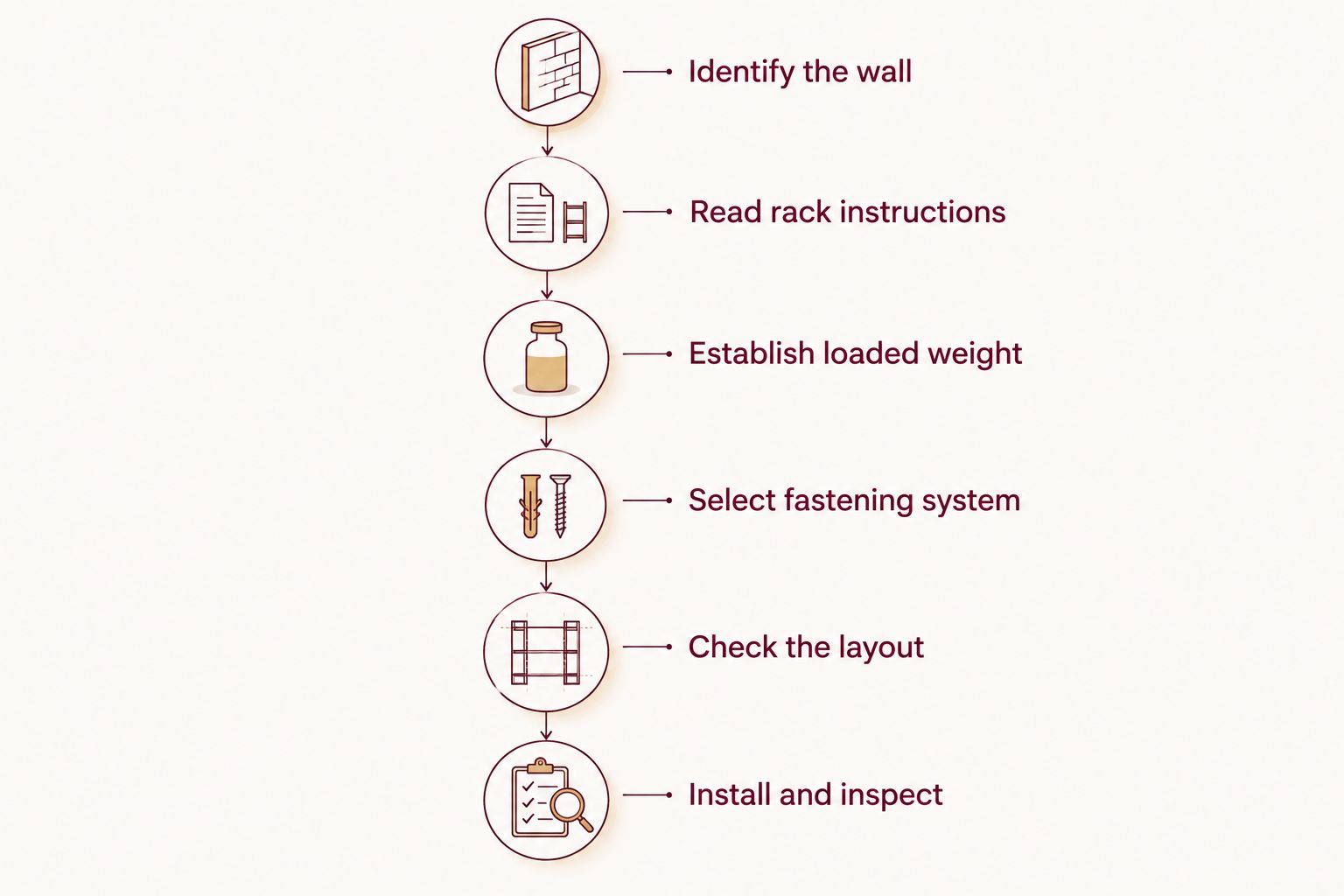
Use this sequence before ordering or installing wall-mounted racking:
- Identify the wall. Establish whether it is concrete, solid brick, hollow masonry block, or a decorative finish over another structure. Do not select anchors from the visible surface alone.
- Read the rack instructions. Confirm that the manufacturer permits your mounting arrangement. Check the required attachment locations and any restrictions on mounting surfaces.
- Establish the loaded weight. Include the rack, full bottles, and accessories. Use verified product weights or actual measurements—not an assumed weight per bottle.
- Select the fastening system. Match the anchor to the base material, wall condition, mounting geometry, and load. Follow the anchor manufacturer’s installation requirements.
- Check the layout before drilling. Locate concealed services, confirm attachment positions, and preserve bottle access and cooling clearances.
- Install and inspect. Follow the specified drilling, cleaning, embedment, and tightening procedures. Do not load the rack until the installation is complete and secure.
An anchor’s suitability depends on its documented installation conditions. A package labeled for masonry does not establish that it is appropriate for every brick, block, or concrete wall.
Why this matters
A wall-mounted wine rack places bottles away from the wall face. That offset creates a turning force as well as downward weight, so bottle count alone does not describe the demands on the attachments.
Your 2026 wine room plan should treat mounting as part of the room design. An attractive elevation is incomplete until you know what supports it, how bottles are removed, and where the cooling equipment needs clear space.
Keep the display design and the attachment design separate until both are verified. Matching a rack’s finish to the room does not establish that its mounting system suits the wall.
Which masonry wall do you have?
Concrete, brick, hollow block, and veneer require different installation decisions. Identify the material at the actual attachment locations; one room can contain more than one wall construction.
| Wall construction | Practical advantage | Main limitation | Best for |
|---|---|---|---|
| Structural concrete | Provides a solid base for compatible concrete anchors | Anchor placement must account for edges, reinforcement, and wall condition | A verified concrete wall with an approved mounting detail |
| Solid brick | Supports masonry-specific fastening when the brick and anchor are suitable | Brick condition and anchor position affect suitability | Sound brick with documented anchor compatibility |
| Hollow masonry block | Offers mounting options designed for hollow substrates | The cavities and block faces require an appropriate fastening approach | Installations with a verified hollow-block anchor system |
| Brick or stone veneer | Provides the desired decorative surface | The finish alone does not establish structural support | Displays attached through to verified backing using an approved detail |
Structural concrete
For concrete, select an anchor whose documentation covers the concrete condition and intended use. Its diameter, embedment, spacing, and distance from edges are installation requirements, not optional preferences.
Do not drill through reinforcement simply to preserve a symmetrical rack layout. If the intended mounting positions conflict with reinforcement or concealed services, have the installer resolve the conflict before proceeding.
Solid brick
Inspect brickwork for cracking, loose units, and deterioration before planning attachments. A neat exposed-brick surface does not establish that every brick is sound.
Do not assume a mortar joint and a brick face are interchangeable anchor locations. Use only the location and substrate covered by the anchor’s instructions, with professional assessment where the masonry condition is uncertain.
Hollow masonry block
Hollow block has cavities, so a fastening arrangement intended for solid concrete is not automatically suitable. Confirm whether the attachment location is hollow or filled and choose a documented system for that condition.
The drilling position matters. Do not improvise by substituting longer screws or tightening harder when an attachment fails to seat properly.
Decorative veneer
A decorative finish changes the mounting detail because the structural support lies elsewhere. The installer must account for the finish thickness and any space behind it without crushing or relying on unsupported facing material.
Treat veneer as a finish until the wall assembly proves otherwise. If the backing cannot be verified, change the rack location or mounting arrangement rather than guessing.
Why masonry mounting requirements vary
There is no universal masonry anchor recommendation for metal wine racks. These factors determine the appropriate installation:
- Base material: Concrete, solid brick, and hollow block require substrate-specific fastening decisions.
- Wall condition: Cracks, loose masonry, and deteriorated joints change whether an attachment location is suitable.
- Loaded weight: The rack and every stored bottle contribute to the load; accessories add to it.
- Rack depth: Bottles projecting farther from the wall increase the turning effect on the attachments.
- Attachment geometry: Mounting-hole positions, anchor spacing, and proximity to edges constrain the installation.
- Wall assembly: Veneer, insulation, concealed services, and structural backing affect where and how you can attach the rack.
For a 2026 installation, obtain the current instructions for the exact rack and anchor—not a detail from a visually similar display. A different bracket or mounting pattern changes the installation you need to verify.
How do you calculate the load on a wine rack?
Start with the rack’s documented empty weight, then add the weight of the full bottles you intend to store. Include any additional components supported by the same attachments.
Bottle volume is not bottle weight. A standard 750 mL bottle, a 1 L bottle, and a 1.5 L magnum contain different amounts of wine, and their glass weights also vary; do not convert the rack’s advertised bottle capacity into a fastening load using an arbitrary allowance.
Use these checks when reviewing capacity:
- Confirm which bottle shapes and sizes the rack accommodates.
- Distinguish bottle capacity from the rack’s permitted load.
- Check the complete configuration, including any added rows or extensions.
- Ask the installer to assess the mounting arrangement under its intended loaded condition.
Do not multiply an anchor’s headline load rating by the number of screws and call the result a safe rack capacity. Attachment groups, load direction, masonry condition, and installation details affect the result. Use a documented fastening design rather than arithmetic detached from those conditions.
How should you plan bottle access and room fit?
Mark the proposed rack footprint before drilling. Show the bracket positions, bottle projection, nearby doors, and the space you need to remove a bottle without striking another surface.
Check the actual bottle mix, not just the collection count. Standard bottles and magnums need different storage accommodations, and a rack that accepts one format does not automatically accept another.
In a cooled wine room, coordinate rack placement with the cooling equipment’s documented airflow and service clearances. Do not place a bottle display across an intake, discharge, or access panel simply because the wall elevation looks balanced.
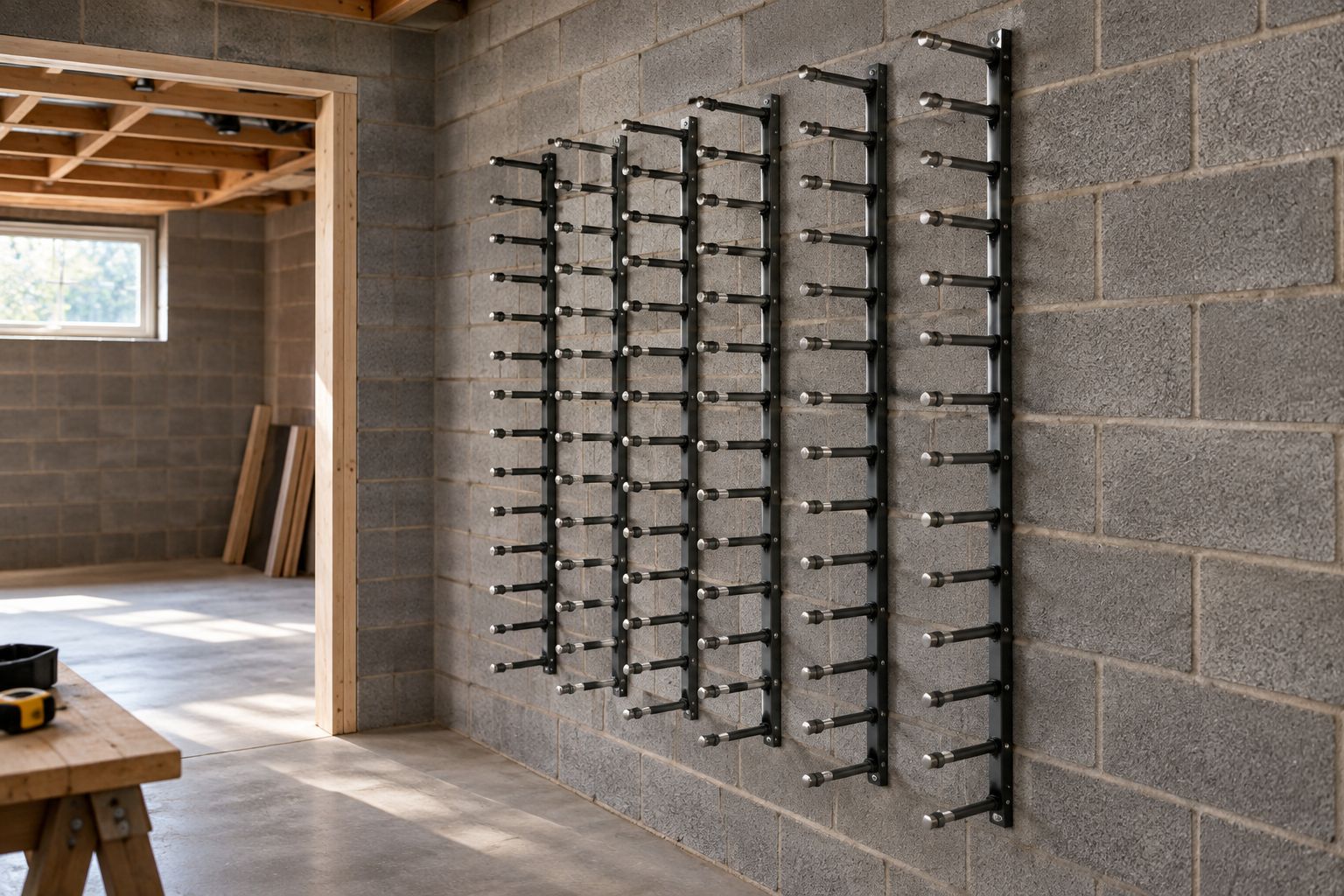
Prepare a simple room sketch with wall dimensions, door swings, electrical locations, and cooling equipment positions. For your 2026 project, this gives the designer and installer the same physical layout to work from before attachment locations become permanent.
What should you do if the masonry wall is unsuitable?
Change the support arrangement instead of forcing a wall-mounted installation. Depending on the room, the next option is a rack attached to verified structural backing, a floor-to-ceiling system, or a wine refrigerator installed according to its own instructions.
| Alternative | Best for | Advantage | Trade-off |
|---|---|---|---|
| Rack attached to verified backing | Homeowners retaining a wall-display layout | Preserves the wall-mounted approach | Requires a suitable, approved connection through the wall assembly |
| Floor-to-ceiling rack | Rooms with unsuitable display walls and suitable floor and ceiling attachment points | Uses a different mounting arrangement | Still needs verified attachment surfaces and model-specific installation |
| Wine refrigerator | Homeowners choosing enclosed, temperature-controlled bottle storage | Combines storage and cooling in an appliance | Needs appropriate room fit, electrical provision, and installation clearances |
Wine Majesty offers the VintageView Helix HX-FCP-10 Single Sided Wine Rack Post Kit, Floor-to-Ceiling Mounted Bottle Storage. Its steel and aluminum alloy column holds bottles in a spiral, label-forward arrangement; consider that format when it suits the room, but verify the floor and ceiling connections before selecting it.
For enclosed storage, the Allavino VSWR56 dual-zone wine refrigerator has listed dimensions of 23.4 inches wide, 33.9 inches high, and 23.6 inches deep. Those dimensions describe the appliance, not a complete installation opening; use its current instructions to establish required clearances.
A refrigerator is not a replacement for a wall display when your priority is an open bottle presentation. Equally, an open rack does not provide temperature control by itself.
Can you install metal wine racks on masonry yourself?
A homeowner installation is appropriate only when you can identify the wall, follow the rack instructions, and install a documented fastening system correctly. Uncertain wall construction or damaged masonry calls for a qualified installer, not experimentation with different anchors.
Professional help is especially useful when the layout involves veneer, concealed services, uncertain backing, or a large interconnected display. The installer’s task is to resolve the attachment detail—not merely drill straight holes.
Before installation, gather the rack instructions, wall information, bottle plan, and proposed layout. Ask for the fastening approach to be specified before work begins so you understand what supports the finished display.
What should you ask before ordering a rack?
Ask whether the exact rack permits your intended mounting surface and arrangement. Then confirm the mounting-hole layout, compatible bottle formats, required hardware, and any installation restrictions.
Wine Majesty is best for homeowners planning wine racks alongside cellar cooling and custom wine room design. For a 2026 cellar plan, share photographs and measurements along with any known wall-construction details; a design discussion does not replace verification of the physical attachment surfaces.
Get the mounting decision settled before choosing a final rack configuration. That sequence keeps the installation requirements tied to the room you actually have.
FAQ
Can metal wine racks be mounted directly on concrete?
Yes, metal wine racks can be mounted on concrete when the rack permits that installation and the fastening system is specified for the concrete and loaded rack. Follow both manufacturers’ installation requirements.
Can I attach a wine rack to brick veneer?
Do not rely on brick veneer alone to support a wall-mounted wine rack. Verify the structural backing and use an approved connection that accounts for the complete wall assembly.
Should wine rack anchors go into brick or mortar?
Use only the attachment location covered by the anchor manufacturer’s documentation. Brick and mortar are not interchangeable substrates, and the condition of the masonry also matters.
Can I use the screws supplied with my metal wine rack?
Use supplied hardware only if the rack instructions identify it as suitable for your wall construction and installation. Hardware intended for another substrate is not automatically suitable for masonry.
How much weight can a masonry-mounted wine rack hold?
The permitted load depends on the rack, fastening system, wall material, and installation details. Use documented limits for the exact configuration rather than estimating capacity from the number of anchors.
Are floor-to-ceiling wine racks better for an unsuitable wall?
Floor-to-ceiling wine racks offer a different mounting arrangement when wall attachment is unsuitable. They still require suitable floor and ceiling connections and compliance with the model’s instructions.
Does a metal wine rack keep wine cool?
A metal wine rack stores bottles but does not provide temperature control. Plan separate room cooling or choose a wine refrigerator when controlled storage is part of your requirement.
One last thing
The strongest-looking wall is not necessarily the easiest place to install a wine rack. A thick decorative stone surface can conceal an attachment problem that a plain, well-documented structural wall does not have.
Before drilling, ask one question: What structural material receives every attachment? If that answer is unclear, stop and resolve it. The finish belongs in the design conversation; the load path belongs in the installation decision.


